Trampoline and snow scooters: what are they and why aren’t they freestyle scooters?
21. October
Entire article
Written by Martin Nogol, Scootshop.cz · Updated on the 14th. 10. 2026
⚡ In short: griptape is self-adhesive sandpaper on a deck. Replace it when it is worn smooth and the boot slips on it; ideally, always at the beginning of the season.
Sold in sheets that are trimmed to the edge of the board after application. It lasts approximately half a year to a year, depending on the boots and riding style. The replacement takes 15–20 minutes: heat the old griptape with a hair dryer and peel it off, clean the deck of adhesive, apply the new sheet, smooth out any bubbles, trim it, and sand the edges.
Wear skate shoes with flat soles on the griptape. Soft running shoes—the grip tape wears through after a few weeks, and the shoe doesn’t hold up.
🧻 Sandpaper
Self-adhesive “sandpaper”. It is sold in sheets and trimmed to fit the board.
📅 Half a year to a year
Depending on the shoes and style. Apply a new one at the beginning of the season.
🔥 Hair dryer and scraper
The heated glue will come loose. Any residue can be removed with alcohol or adhesive remover.
✂️ Trim and sand
File the edge, then cut.
The edge does not lift afterward.👟 Skate shoes
Flat sole. Running shoes will ruin the griptape and won’t grip.
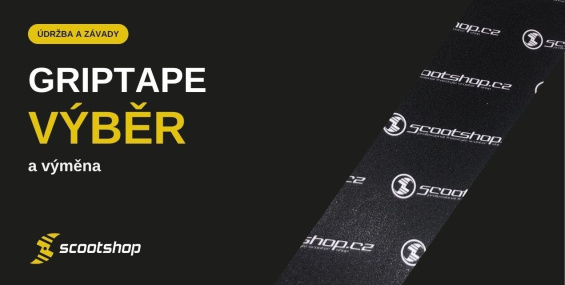
Griptape (riders call it “grip” or “sandpaper”) is self-adhesive sandpaper stuck to the top of the deck. It does one thing: keeps the boot on the board. During a jump, tailwhip, or one-footed landing, the griptape determines whether your foot stays on the board or slips off.
Sold in sheets that are wider and longer than the board. After application, the excess is trimmed along the edge of the board; one sheet is enough for one board. Griptape is a consumable part: it gets worn down by shoes, clogged with dust, and eventually stops providing grip. Replacement is one of the cheapest and easiest scooter repairs.
The choice is simple. Grip tape for freestyle scooters differs mainly in grit and graphics. A coarser grain offers more grip but wears out shoes faster; a finer grain is gentler on shoes. For children and beginners, a standard medium coarseness is perfectly fine. You can find the selection in the maintenance and freestyle scooter parts categories.
Grip tape lasts approximately six months to a year. It depends on the shoes (a thick sole will wear it down faster), the riding style (lots of whips and landings on one foot), and whether the rider rides in wet or dusty conditions. Replace it when you see or smell this:
Practical recommendation: always apply new griptape at the beginning of the season, along with a full scooter inspection. It’s an inexpensive part, and the scooter handles noticeably better with a new grip. If the rider wears it out during the season, simply replace it again.
💡 Extending lifespan
Clean the grip tape dry with a stiff brush (an old toothbrush or shoe brush will do).
It will remove the dust and some of the grip will return. Do not clean it with water or a wet cloth; water will work the grit in even further and loosen the adhesive around the edges.The most labor-intensive part of the replacement. The old grip tape adhesive sticks firmly to aluminum, but softens with heat. You will need a hair dryer (or a heat gun on its lowest setting), a plastic or metal scraper, a cloth, and denatured alcohol or adhesive remover.
If you're applying griptape to a brand-new deck, you can skip this step—just wipe off any dust and degrease the deck with rubbing alcohol.
You’ll need a new sheet of grip tape, a utility knife with a new blade, a file (or another metal object with an edge, such as an Allen key or screwdriver), and a clean deck. Work at a desk, not on your lap.
💡 Shoes and griptape go together
Griptape is sandpaper, and the shoe is what rubs against it. Skate shoes with a flat, even sole are best for freestyle scooters: they provide full-surface grip and are durable. Running shoes will wear through grip tape in just a few weeks; they also provide less grip because only the raised sections of the deck make contact. Sandals and open-backed shoes are not suitable for riding a scooter at all.
| ❌ Mistake | 💥 Consequence | ✅ Correct approach |
| Applying it to an uncleaned deck | The griptape starts peeling at the edges after just a few rides, and water seeps underneath. | Dissolve adhesive residue with alcohol, degrease the board, and let it dry. |
| Entire backing paper removed at once | The sheet sticks crookedly or to itself and cannot be fixed. | Peel back just the end, apply it, then gradually pull off the rest. |
| Bubbles left underneath the griptape | The griptape tears at the bubble and begins to peel off. | Push from the center outward; prick the remaining bubbles with a pin. |
| Cut without edging | Uneven edge; the overhangs lift up and catch on shoes. | First trace the outline with a file, then cut along the white line. |
| Dull blade | The griptape tears instead of cutting, and the edge is frayed. | A new blade in a snap-off knife, a cut in one stroke. |
| Griptape over the brake or flex fender | The brake does not flex properly, and the griptape wears off it immediately. | The grip tape ends before the brake; trim it at the brake using the tip of a knife. |
| Riding in running shoes | The new grip tape is worn smooth after a few weeks, while the shoe still slips. | Skate shoes with a flat sole. |
| Cleaning with water | The grain gets clogged even more, and the adhesive around the edges loosens. | Dry-brush with a stiff brush. |
Roughly once every six months to a year, depending on the boots and riding style. The simplest rule: replace your grip tape at the start of each season, and during the season as soon as your boot starts to slip.
Any griptape designed for freestyle scooters; sold in sheets that can be cut to fit the deck. The differences are mainly in the grain coarseness and the graphics. For children and beginners, a regular medium grit is ideal.
Most often, the board was greasy or had traces of old adhesive when it was glued, or the edge had not been sanded. A small lifted section can be heated with a hair dryer and pressed down; if it is coming loose in several places, replace the entire sheet and degrease the board thoroughly this time.
Brush dry with a stiff brush. The grain dust falls out and the grip partially returns. When the grit has become worn smooth (shiny and smooth to the touch), cleaning won’t help—it’s time for a new sheet.
For a few rides, yes, but not in the long term. The soft, contoured griptape wears smooth quickly, frays on its own, and the shoe grips the board less effectively. Flat-soled skate shoes are essential for freestyle scooter riding, just like a helmet.
Visit our store in Pardubice, and we’ll replace your griptape on the spot—even on a scooter purchased elsewhere. Griptape and other consumable parts can be found in the maintenance category. For what else to check at the start of the season, see the article Pre-Ride Inspection and Regular Freestyle Scooter Maintenance . Find more guides in the Guides section.