Trampoline and snow scooters: what are they and why aren’t they freestyle scooters?
21. October
Entire article
Written by Martin Nogol, Scootshop.cz · Updated on the 14th. 10. 2026
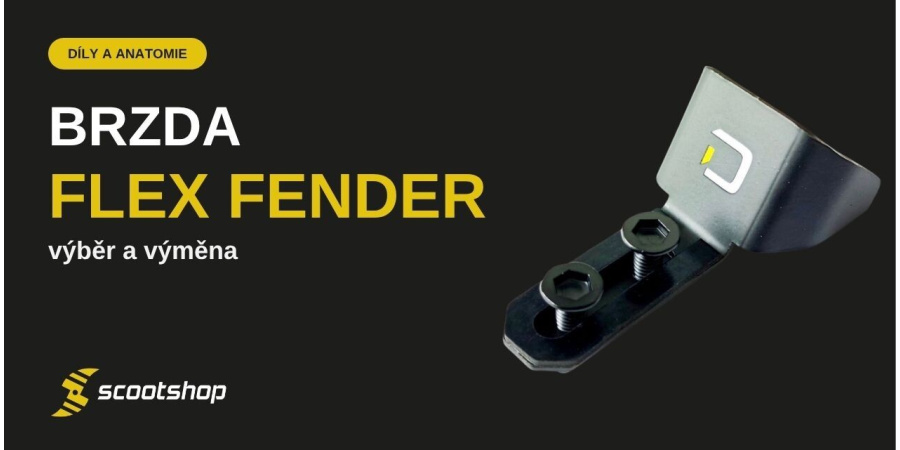
⚡ In brief: today’s brake is a flex fender, a flexible metal plate bolted to the deck.
Choose the brake according to the deck (it must fit its mounting holes) and the wheel diameter: a brake for 100 mm wheels will not fit a 110 mm wheel, and a brake for 120 mm wheels should not be used with a smaller wheel.
The spring brake is a thing of the past; you'll only find it on cheap, old scooters.Brake briefly and gently; to slow down from speed, it’s better to put your foot on the ground. Prolonged braking creates a flat spot on the wheel, making it unusable.
🛑 Flex fender = standard
Flexible sheet metal without a spring or pin. Quiet, light, simple.
📐 Always according to the board
The brake must fit the holes and shape of the specific board. The safest bet is the same brand.
🛞 100 / 110 / 120 mm
The brake is designed for the wheel diameter. 110 mm will not fit under a 100 mm brake.
🔩 3 or 4 mm Allen key
Brake screws are usually small. Do not overtighten; it will strip the thread.
🚫 Don’t slam on the brakes
Locked wheel = flat spot.
The wheel then rattles and can be thrown away.The brake on a freestyle scooter is a fender above the rear wheel that you press with your heel. Today, practically only one type is used:
Flex fender (flex brake). A bent sheet-metal piece in the shape of a fender, screwed to the rear of the board with one or more screws (from above or below). It has no spring or pin: when pressed down, the metal plate bends toward the wheel, then returns to its original position when released. It is quiet, lightweight, and simple—there’s nothing to rattle. The drawback is material fatigue at the bend: after prolonged use, the sheet metal loses its elasticity or cracks, and then it is replaced. Small and lightweight children sometimes have difficulty pressing it down.
According to the material, we distinguish:
Spring brake is a thing of the past. It sits on a pin in the plate and is held above the wheel by a spring; it is tightened from the side. It has multiple parts, needs to be tightened, the spring wears out, and then the brake rattles. You’ll find it on the cheapest and older scooters. If your board has holes for a flex fender, switching to one is the first sensible upgrade.
The brake must meet two requirements at once. Always choose it based on the specific board, not the scooter brand in general.
In practice: when switching from 100 mm to 110 mm wheels, you usually also need a new brake, and it must be compatible with your deck. Whether a larger wheel will also fit in the deck and fork is covered in the article Which wheel fits my fork, deck, and under the brake? Do not bend the brake “to make a larger wheel fit”: the metal plate will crack and you will lose your warranty.
The brake on a freestyle scooter is more of an aid than the main brake. Teach a child three things:
A freestyle scooter isn’t designed for riding down long hills; that’s what city scooters with large wheels are for. A flat spot on the wheel is not a manufacturing defect.
| 🔎 Symptom | ❓ Most common cause | 🔧 Solution |
| Brake rattles or clatters while riding | Loose brake bolt, or the plate rattles against the board over every bump | Tighten the bolt (3 or 4 mm Allen key); do not overtighten. If the knocking continues, check whether the brake is bent or cracked. |
| Brake rubs against the wheel even when not pressed | Incorrect size (a 110 mm wheel under a brake for a 100 mm wheel), a bent plate, or a worn-out brake that no longer springs back | Check the brake size against wheels. Replace a bent or warped brake; do not try to straighten it. |
| The brake feels “soft,” doesn’t brake, and only reaches the board | Material fatigue; the metal has lost its elasticity (the brake has been worn down), or the wheel is worn and there is too much clearance above it | Replace the brake. If the wheel is worn, replace the wheel first: a new brake will also crack over a small wheel. |
| Cracks in the sheet metal bend | Material fatigue, often accelerated by a worn wheel or an incorrectly sized brake | Replace immediately. A cracked metal sheet may break off while braking. |
| Plastic brake worn down to the metal plate | Normal wear of the plastic | Replace it, preferably with a steel one, if one is available for the board. |
| Wheel rattles after braking | Flat spot on the wheel caused by locking up | The brake is fine; replace the wheel and brake more gently. |
If your scooter is knocking and you’re not sure whether it’s the brake, axle, or headset, follow the diagnostic guide “Scooter rattles or knocks, or the handlebars are loose” .
Replacing the flex fender takes a few minutes. Tools: 3 or 4 mm Allen key for the brake bolts (depending on the manufacturer), 6 mm Allen key and, if necessary, a 13 mm wrench for the rear wheel axle.
💡 Adjustment
The Flex fender is not adjustable; its position is determined by the shape of the sheet metal and the plate. The only things you need to check are that the screws are tight (at the start of the season and whenever the brake rattles) and the clearance above the wheel: if the brake rubs against a new wheel of the correct size, it is bent and should be replaced. On an older spring brake, the position is adjusted with a side screw; if you have to tighten it every week, it’s time for a flex fender.
A flex fender from the same brand and type as your deck, sized according to the wheel diameter (most commonly 110 mm). Don't buy a spring brake anymore.
Usually not; the hole spacing and shape differ. Universal brakes for which the manufacturer specifies particular brake pads are an exception. If you're not sure, send us a photo of the back of the board.
No. You need a brake for 110 mm wheels that also fits your deck. A 100 mm wheel under the brake instead of a 110 mm one works.
Based on its condition, not the calendar: when it cracks, loses its elasticity, or is worn through. At the beginning of the season, check that the bolts are tight and that the sheet metal is free of cracks. A brake that breaks after just a few rides may be due to a material defect. Please follow the instructions in How to Make a Warranty Claim.
Bring your scooter to our store in Pardubice. We’ll select and replace the brake on the spot, even for scooters purchased elsewhere. You can find the selection in the brakes, decks, and wheels categories. Related articles: How to choose wheels, Bearings for a freestyle scooter, and How to assemble a new freestyle scooter. Another guide in the Guides section.