Trampoline and snow scooters: what are they and why aren’t they freestyle scooters?
21. October
Entire article
Written by Martin Nogol, Scootshop.cz · Updated on the 14th. 10. 2026
⚡ In brief: a freestyle scooter is for jumps, a regular one is for riding.
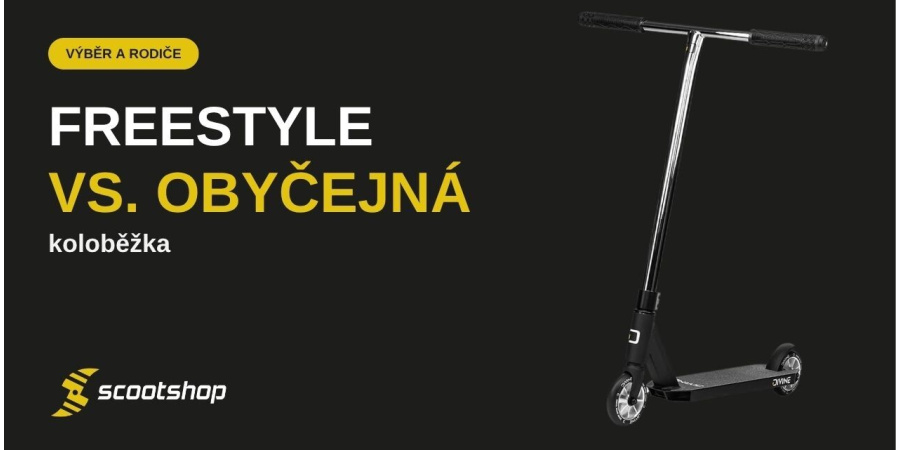
A freestyle scooter has a solid frame with no folding joint, non-adjustable handlebars, small hard wheels (usually 110 mm), and weighs 3–4 kg.
A regular scooter (folding, city, or children’s) has a folding joint, telescopic handlebars, and larger, softer wheels, making it comfortable to ride, but it won’t withstand jumps.If a child wants to go to a skatepark and learn tricks, they need a freestyle scooter. If she wants to ride around the park, go on outings, and go to the playground, she needs a regular one. There is no single scooter for both.
🔩 No joint
A freestyle scooter has no moving joint between the deck and the handlebars.
🛞 110 mm
The most common wheel diameter. An ordinary scooter has significantly larger and softer wheels.
⚖️ 2–3× the rider’s weight
This is how much force acts on a scooter when landing from a jump. Only freestyle is designed for that.
🧰 Building kits
With Freestyle, every part can be replaced.
With a folding one, usually nothing.🚫 Not for trips
A freestyle scooter is slow, hard, and uncomfortable over a 20 km ride.
By “ordinary scooter,” we mean a folding scooter for children, city use, or trips. It differs from freestyle in every component, because each component addresses a different task: riding comfortably over long distances or surviving an impact.
| Part | 🛴 Freestyle scooter | 🚲 Ordinary / folding scooter |
| Frame and joint | Deck made from a single piece of aluminum. The fork, handlebars, and deck are clamped together into a single rigid unit by the compression system. No movable joint. | Folding joint secured with a lever or pin. It has play from the factory, and it gets worse with every jump. |
| Handlebars | One piece of steel or aluminum in a T or Y shape, fixed height. Diameter 32 or 35 mm, selected according to the rider’s height. | Telescopic, two- to three-section, secured with a quick-release clamp or pin. Every joint is a weak point. |
| Wheels | Small and hard: 100–120 mm, most commonly 110 mm, polyurethane with a hardness of approximately 85–88A, aluminum core. They accelerate quickly and withstand impacts. | Larger and softer, often with a plastic core; used for recreational and inflatable boats. Comfortable to ride, they deform upon impact. |
| Bearings | Standard 608 (8 mm axle), two per wheel. You can buy them anywhere and replace them in just a few minutes. | Often the same size, a cheaper version. An exchange is generally not expected. |
| Brake | Flex fender: a flexible plate above the rear wheel, screwed to the deck. No spring, few parts. | Step-on fender with spring, sometimes a handbrake. More parts, more noise. |
| Weight | Approximately 3–4 kg. Lighter for a child, firmer for an adult. | A lighter folding stroller for children; a heavier travel stroller with large wheels. |
| Load capacity | Sets typically up to 100 kg (standard EN 14619 covers riders weighing 20–100 kg). It also applies to impacts. | Children’s folding models tend to have a lower weight capacity, while city models are around 100 kg. Applies to riding, not jumping. |
| Price | A reasonable starting point is CZK 2,000–4,000, depending on the rider’s size. Under CZK 2,000, we don’t recommend it for tricks. | From a few hundred crowns to thousands. The price says nothing about whether it can withstand jumps. |
For a detailed breakdown of each component, see the article What Is a Freestyle Scooter Made Of? ; for the complete selection process, see the guide How to Choose a Freestyle Scooter for a Child or Beginner.
Upon landing from a jump, the scooter is subjected to 2–3 times the rider’s weight. For a child weighing 35 kg, the impact force is around 100 kg; for an adult, it is over 200 kg. The joint between the handlebars and the deck has to absorb the impact. Every moving part in it (joint, telescopic section, pin, quick-release mechanism) has play, and that play increases with every impact.
That’s why the freestyle scooter has no moving parts in this area. The handlebars fit onto the fork steerer tube, which passes through the headset (the bearings that allow the handlebars to turn), and the whole assembly is tightened by the compression system: a bolt that takes up any play and a clamp that grips the handlebars. The result is a rigid unit that behaves as if welded together, but can be disassembled piece by piece.
Handlebar height is therefore adjusted differently than with a telescopic mechanism: handlebars are purchased at a specific height, and when the child grows, they are replaced with taller ones.
The exact dimensions based on the child’s height are in the article Scooter Size by Height and Age .💡 How to recognize a genuine freestyle scooter at first glance
Check the connection between the handlebars and the board. The true freestyle setup has only a 2–4-bolt clamp on the fork, tightened with an Allen key, with a top cap above it. No lever, no pin, no height scale. As soon as you find anything on it that can be switched by hand, it’s not a freestyle scooter, no matter what it says on it.
We see it at the skatepark every week. The sequence is always the same:
It’s not just about a destroyed scooter. A joint that gives way on impact means a headfirst fall. Once a child starts jumping, it’s time for a freestyle scooter, not a sturdier folding one.
The reverse is also true. A freestyle scooter is great for jumps and bad for 15 km on a bike path:
If your child mainly rides around the city and goes on trips, an ordinary scooter with larger wheels will make them happier. A freestyle scooter makes sense when you want to jump.
The most common mistake parents make. A scooter with small wheels and the word “stunt,” “freestyle,” or “sport” on it is standing in a hypermarket. It looks like you at the skatepark and costs a fraction of the price. At the junction of the handlebars and the board, however, you’ll find one of two things:
Both are precisely the mechanism that cannot withstand jumps. Typically wheels with plastic hubs, a non-integrated headset, and parts in non-standard sizes that you won’t be able to buy anywhere a year later. It’s an ordinary scooter dressed up as a freestyle scooter.
💡 Three questions to protect you
1. Can it be folded or adjusted in height? If so, it’s not freestyle. 2. What compression system does it have (SCS, HIC, IHC)? If the seller doesn’t know, it isn’t freestyle. 3. Will I be able to get a replacement 110 mm wheel and 608 bearings for it in a year? If not, it’s a scooter for one season. More in the article Freestyle scooter from a chain store or a specialist shop?
| Situation | Recommendation |
| Child aged 4–6, rides around the playground and on walks | A regular children's scooter. Freestyle only if it wants to go to the skate park on its own and can carry 3 kg. |
| Child aged 7–12, goes to the skatepark with friends and tries doing jumps | Freestyle scooter, CZK 2,000–3,000, size based on height. |
| The child has a folding scooter and has started jumping on it | A freestyle scooter—the sooner, the better. Save the folding one for trips. |
| Teenager or adult, tricks, park, street | Freestyle scooter, CZK 2,500–4,000 to start, sturdier parts to accommodate greater weight. |
| Trips along bike paths, longer rides around town, transport in a car | A regular city or touring scooter with large wheels. Freestyle doesn’t make sense here. |
| Wants to do both: ride and jump | Two scooters, or decide based on what they do more often. There is no compromise. |
A freestyle scooter has a rigid frame without a hinge, fixed handlebars, small, hard wheels (usually 110 mm) and is designed to withstand impacts from jumps. The standard model has a folding joint, telescopic handlebars, and large soft wheels for a comfortable ride.
From the curb, yes. Not at a skatepark: the joint and telescopic handlebars can come loose, and then the deck may crack at the joint.
No. It can only be disassembled using an Allen key (remove the handlebars). It has no folding mechanism, and that is intentional.
Yes for short trips over a smooth surface. Not for longer trips: the small, hard wheels are slow and uncomfortable, and the scooter cannot be folded.
According to the handlebar-to-deck connection. If it can be folded or adjusted vertically, it has a joint or telescopic mechanism and therefore won’t withstand jumps. The right freestyle only has a clamp with bolts and a top cap.
A decent freestyle scooter for a beginner costs CZK 2,000–4,000. Why is it more expensive than a scooter from a hypermarket? We explain in our article How much does a freestyle scooter cost, and what do you get for the price?.
Write to us or stop by our store in Pardubice, and we’ll help choose a scooter for your child and adjust it on the spot. You can find all complete scooters in the freestyle scooters category, and more guides in the Guides section.