Trampoline and snow scooters: what are they and why aren’t they freestyle scooters?
21. October
Entire article
Written by Martin Nogol, Scootshop.cz · Updated on the 14th. 10. 2026
⚡ In short: We strongly recommend wearing a helmet at all times, for children and adults alike, on the street and at the skatepark.
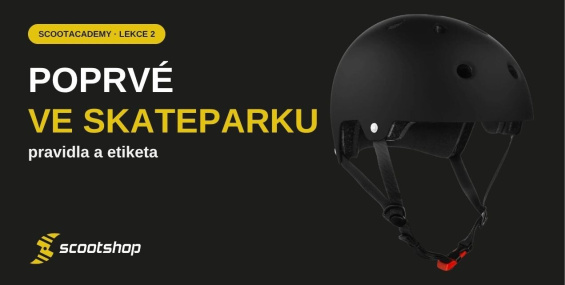
For freestyle scootering, choose a hard-shell skate helmet that also covers the back of your head and is certified to EN 1078. Determine the size based on head circumference in centimeters, not age. Replace the helmet after every hard fall.
Knee, elbow, and wrist pads are essential for beginners in their first few months. A mouthguard and gloves are sensible additions; sturdy shoes with flat soles are essential for everyone.
🪖 Helmet at all times
For children and adults, on the street and at the skatepark. Falls on the head are most common among beginners.
🪖 Skate, not cycling
Hard shell, covers the back of the head, withstands multiple minor impacts.
📏 Head circumference in cm
Measuring tape 1–2 cm above the eyebrows. Size is not selected based on age.
🦵 Shin Guards for Beginners
Knees, elbows, wrists. During the first few months, a child mainly learns how to fall.
🔁 Replace after a fall
A helmet loses its protective properties after a hard impact, even if it looks fine.
A helmet is strongly recommended at all times, for children and adults alike, on the street and at the skatepark. Not because someone requires it, but because head injuries are the most common injury among beginners, in both places:
The most common head injuries don't happen during big tricks, but because of simple mishaps: the front wheel slips on the edge of a ramp, the handlebars get stuck during a botched barspin, or a child fails to see another rider. They are all backward falls or falls to the side, onto the back of the head and temples. Precisely where a skate helmet protects you and a cycling helmet doesn't (see below).
💡 How we do it at Scootshop
We recommend a helmet for every rider, regardless of age or location. An argument for a child who doesn’t want one: racers wear one during competitions and also ride in one during practice. And most skateparks require it for children in their rules of operation.
Both can have the same certification, but they are designed for different types of falls: a cycling helmet for one forward fall while riding, and a skate helmet for repeated falls in all directions.
| 🛹 Skate helmet | 🚴 Bicycle helmet | |
| Construction | Hard ABS shell as a separate layer + inner foam (EPS or softer EPP). | “In-mold”: a thin shell molded directly into the EPS foam. One piece, lower weight. |
| What it covers | The entire skull, including the back of the head and temples; sits lower. | Mainly the crown and forehead; the back of the head is open for ventilation. |
| How many impacts it can withstand | A hard shell can withstand multiple minor impacts; EPP foam can withstand repeated impacts as well. It changes anyway after a hard fall. | Built for one impact. The EPS foam is permanently compressed in a crash, so the helmet must be discarded. |
| Weight and ventilation | Heavier, fewer ventilation holes. | Lighter, with many holes; more comfortable in summer. |
| For freestyle | Yes. Falls in the park are backward and to the side, exactly where a skate helmet offers more coverage. | Better than nothing if the child already has one. Not for regular riding in the park. |
What does EN 1078 mean? European standard for helmets “for cyclists and users of skateboards and roller skates”. A helmet bearing this marking has passed tests for impact absorption (falling onto both a flat and an angular anvil, with head acceleration below 250 g), strap strength, and resistance to coming off the head during an impact. The marking is on the label inside the helmet, together with the CE mark. For young children, there is a derived standard, EN 1080, with a buckle that releases if it gets caught; EN 1078 is sufficient for a scooter.
A helmet without certification may look the same and have foam that does not absorb impacts. In the helmets category, we only offer certified helmets.
Helmet size is given as the circumference of the head in centimeters (for example, 48–52 or 54–58 cm), not according to age. Two eight-year-old children can have head circumferences of 50 and 55 cm.
You can find the size ranges for individual brands in our size charts.
💡 Properly Fitted Helmet Test (30 seconds)
Position: horizontal, with the front edge 1–2 finger widths above the eyebrows; a helmet tilted back does not protect the forehead. Side straps: form a “V” just below the earlobe. Buckle: one finger should fit under the chin strap, no more. Test: The child shakes their head and opens their mouth wide. The helmet must not move independently and should press lightly on the crown of the head when the mouth is opened. If it can be pulled down over the forehead without undoing it, the straps are loose.
Tighten the adjustment wheel at the back only after adjusting the straps. The little wheel only adjusts the helmet; in a fall, the straps keep it on your head.
Do not leave the helmet in a car behind the window in summer, and do not wash it in hot water; both can damage the foam.
A helmet protects against the worst injuries, while protective gear protects against the most common ones. A beginner falls onto their hands, knees, and elbows easily ten times in an afternoon. Without protective gear, it means scrapes and fear of trying again; with protective gear, the child gets back up and keeps going. For the first few months, they’re a necessity, not a choice.
| 🛡️ Protective gear | 👤 Who it’s for | ⏱️ Our recommendation | 👀 What to look out for |
| 🪖 Helmet | Every rider, without exception | Always, for children and adults, on the street and in the park | Skate-style, EN 1078, correct head circumference, adjusted straps, replace after a fall |
| 🦵 Knee pads | Beginners, children up to around 12, anyone learning a new trick | During the first few months of riding and when learning jumps on ramps | Hard plastic cap, two hook-and-loop straps, must not slip down the calf. |
| 💪 Elbow pads | Beginners, younger children | Along with knee pads during the first season | Smaller than knee pads; must not restrict arm movement. The hands grip the handlebars, and the elbow hits the ground first. |
| ✋ Wrist guards | Beginners; the most common fracture in children is a wrist fracture | For the first few months; longer for younger children | A firm splint on both the palm and the back of the hand. At the same time, the grips must be easy to squeeze, otherwise the child will remove them. |
| 🦷 Mouthguard | Riders learning barspins, whips, and handlebar tricks; racers | Recommended when learning handlebar tricks | The handlebars can fly into your face when a trick goes wrong. Moldable mouthguard (heat in water and bite down). A special type of braces. |
| 🧤 Gloves | Anyone; especially for street riding and cold days | Optional | Protects your palms from abrasions and keeps sweat off the grips. Thin gloves with a good grip; thick winter gloves make handling more difficult. |
| 👟 Shoes | Every rider | Always | Skate shoes with a flat rubber sole and reinforced toe. Griptape (the rough “sandpaper” on the board) will wear through soft running shoes in just a few weeks; a thick sole makes it harder to feel the board. |
How should protectors fit. Firmly, but it must not constrict. Try them in motion: squatting, arms raised, gripping the handlebars. A guard that slips down to your ankle after three jumps is useless. Choose the size based on the circumference of your knee, elbow, or wrist using the size charts; sets and individual items can be found in the protective gear category.
💡 When to remove the protectors
Advanced riders usually don't wear knee and elbow pads; they know how to fall, and the pads restrict them. For a child in their first season, keep wrist and knee protection on at least until they can ride confidently in the park. The helmet stays on at all times.
We strongly recommend always wearing a helmet, for both children and adults, on the street and at the skatepark. Falls on the head are the most common injury among beginners, and concrete doesn’t care where you stand. The operating rules of most skateparks also require it for children.
Skate helmet with a hard shell that covers the back of the head, certified to EN 1078. A bicycle helmet is an emergency solution, not equipment for regular riding in the park.
Measure the circumference of your head with a tailor's tape measure 1–2 cm above the eyebrows and around the back of the head. Compare the result in cm with the helmet range. If you are between two sizes, choose the smaller one; never size up.
Beginner, yes: knees, elbows, and wrists. The most common scooter injury in children isn’t a head injury, but a broken wrist from falling onto an outstretched hand. After the first season, you can gradually stop wearing protective gear, but keep wearing the helmet.
Sturdy skate shoes and a properly assembled scooter. The guide How to choose a freestyle scooter for a child or beginner will help you make your choice, including choosing the correct handlebar height.
Write to us or visit our store in Pardubice. We’ll measure and adjust the helmet and protective gear for your child on the spot. You can find the selection in the helmets and protective gear categories, and more guides in the Guides section.