Trampoline and snow scooters: what are they and why aren’t they freestyle scooters?
21. October
Entire article
Written by Martin Nogol, Scootshop.cz · Updated on the 14th. 10. 2026
⚡ In short: the wheel has to pass through three places. With a fork, a deck, and a brake.
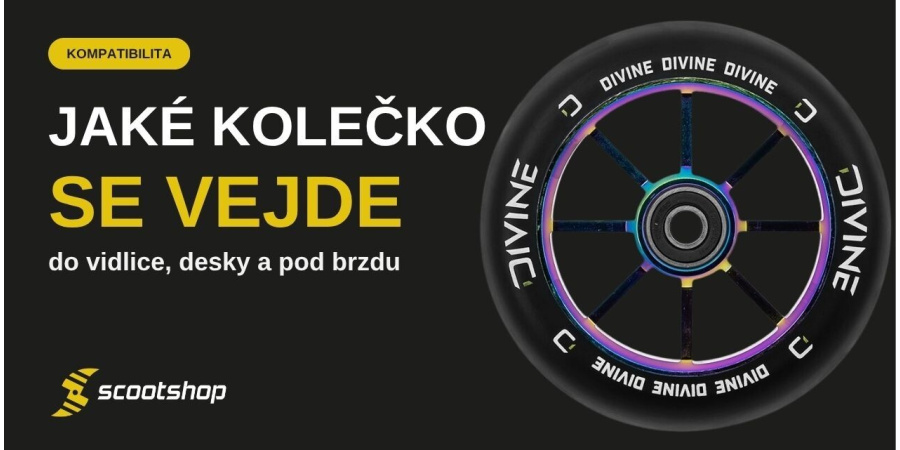
The surest approach: measure the existing wheel (diameter and width, for example 110 × 24 mm) and buy one of the same size. A wheel like this always fits. The smaller diameter fits everywhere; a narrower wheel can fit into a wider fork with spacers. Use a larger or wider wheel only where explicitly specified by the fork and deck manufacturer.
Watch out for the brake: a 110 mm wheel will not fit under a 100 mm brake. When the wheels are enlarged, the brake changes too. If you're not sure, email us or call the store and we'll verify the size.
🛞 110 × 24 mm
Today's standard. Fits most forks, decks, and underneath most brakes.
📏 Measure what you have
The same size as the existing wheel always fits.
🧩 Narrower, yes; wider, no
24 mm into the fork on a 30 mm one works with spacers.
30 mm into a fork with 24 mm? No.🔩 8 mm shaft
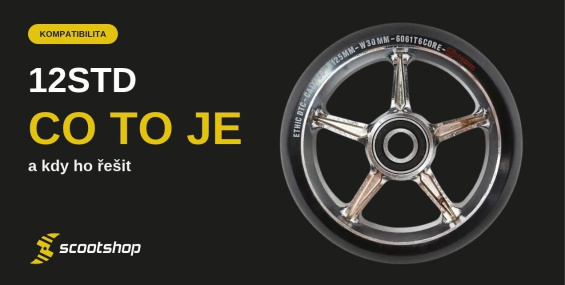
Standard with 608 bearings. 12STD (12 mm axle) is marginal.
🛑 Brake by average
A 110 mm wheel will not fit under a brake designed for 100 mm wheels.
A freestyle scooter wheel is described by two numbers: diameter × width in millimeters, for example 110 × 24 mm. The diameters are 100, 110, and 120 mm (125 mm is hardly manufactured anymore), with widths of 24 mm (standard) and 30 mm (wider, more for street use). Each of these dimensions must pass through three points on the scooter.
The front and rear wheels are commonly purchased in the same size. You’ll find all three limits for every fork, board, and brake in the product description; if any are missing, that’s a sign you should ask.
The easiest way is to read it on the wheel: most manufacturers print the size on the side of the core or on the polyurethane (e.g. “110 mm” and “24 mm”). If the inscription is worn, measure:
The second way is the product description: for a complete scooter, fork, or deck, you’ll find which wheel size it’s designed for. For sets, the wheel size is usually listed directly in the specifications.
💡 How can I tell if the wheel is worn out and needs replacing?
The polyurethane is significantly thinner than when new (on a 110 mm wheel, roughly 2–3 mm remains above the core; some low-profile wheels have thinner PU from the factory, so always compare it with a new wheel of the same type), the wheel has flat spots caused by braking and bounces while riding, or the polyurethane is peeling or tearing away from the core.
A worn wheel is also dangerous for the brake: the flexible fender brake has to bend further and may break. The rear wheel wears down faster than the front one, so it’s a good idea to swap them around occasionally. You can find wheels in the freestyle scooter wheels category. For a guide to choosing wheels by hardness and core, see Choosing wheels.Narrower to wider, yes. A 24 mm wheel can fit in a fork or plate designed for 30 mm: the 6 mm difference is taken up by spacers (spacer rings fitted onto the axle on both sides of the wheel). Forks and plates for 30 mm usually come with spacers for 24 mm; if not, they can be purchased separately. Without spacers, the wheel would be pulled to one side when the axle was tightened, and the bearings would be damaged.
From wider to narrower, no. A 30 mm wheel will not fit into a fork or plate designed for 24 mm; it simply won’t fit between the arms. Generally, the answer is “no”; there are exceptions depending on the product, but don’t count on them. 30 mm wheels are also used less because of their weight, especially for street skating.
An 8 mm axle is standard on wheels, forks, and decks, so you usually don’t need to worry about it. Only with 12STD (12 mm axle, different bearings) does it work in one direction: a 12STD fork and deck can be fitted with standard 8 mm wheels using an adapter, but a 12STD wheel cannot be fitted onto standard 8 mm parts. Bearings are sold in sets of 4 (2 per wheel + spacer). You can find them in the bearings category; see the How to replace bearings guide for instructions.
120 mm wheels: they’re no longer used much in skateparks because of their weight; they’re better suited to street riding and taller riders. Whether they fit your fork and deck always depends on the specific product; with complete setups for children and beginners, assume they won't. You can find forks in the forks category and decks in the decks category.
| 🔁 Transition | 🔱 Fork | 🛹 Deck | 🛑 Brake | 🧩 Spacers / other |
| same size → same size | Nothing. | Nothing. | Nothing. | Bearings only, if they are not included in the wheel (they usually are). |
| 100 → 110 mm | Check the fork's maximum travel. On older and inexpensive 100 mm wheelsets, the fork is often new. | Check the board’s maximum capacity. It’s not possible with boards built only to 100 mm. | New brake for 110 mm. It does not fit under the 100 mm brake. | Same 8 mm shaft. |
| 110 → 100 mm | Nothing, the smaller one will fit. | Nothing. | Also works with a 110 mm brake, though braking performance is slightly worse. Better brake for 100 mm. | Nothing. The scooter will be 5 mm lower. |
| 110 → 120 mm | Only forks specified for a maximum of 120 mm; otherwise, a new fork is required. | Only the board with the stated maximum of 120 mm; otherwise, a new one. | New 120 mm brake. | Always check with the specific product. We do not recommend it for the park or for children. |
| 24 → 30 mm width | Only the fork for 30 mm; otherwise, a new one. | Just the board for 30 mm, otherwise new. | The brake must be wide enough; check with the board. | Longer axles, if they are not included with the fork and deck. Product by product. |
| 30 → 24 mm width | Nothing, with spacers. | Nothing, with spacers. | Nothing. | Spacers on both sides of the wheel (often included with the fork/deck). |
| 8 mm shaft → 12STD | New 12STD fork. | New 12STD board. | According to the board. | Wheels and bearings for 12STD. Practically a new scooter; no point for beginners. |
A summary of all parts and their compatibility can be found in the pillar article Freestyle scooter part compatibility: what fits with what. Brakes for individual diameters can be found in the brakes category.
Only if the fork and deck allow it (check the product description), and only with a new brake for 110 mm wheels. With cheap 100 mm setups, it usually isn’t possible without replacing the fork.
Only if the manufacturer explicitly specifies this for both, and you need a 120 mm brake. It always varies from product to product. For a child and the park, stick with 110 mm.
Yes, with spacers on both sides of the wheel. Conversely, a 30 mm wheel won’t fit in a 24 mm fork.
Using a ruler, measure across the center from edge to edge of the polyurethane. A worn wheel will show a few mm less; round up to 100, 110, or 120 mm. Width is measured on the riding surface: 24 or 30 mm.
The same diameter, yes; otherwise, the scooter stands crooked and handles differently. Buy in pairs or at least in the same size.
A non-standard with a 12 mm axle and different bearings, used mainly by Ethic. In the Czech Republic, it’s not used much and is being phased out. A beginner doesn't need it; the standard is an 8 mm axle.
Take a photo of the side of the wheel and the clamp, and write to us, call us, or visit our store in Pardubice. We’ll check the size and replace the wheels right away, even on a scooter bought elsewhere. Wheels are in the wheels for freestyle scooters category. Find more guides in the Guides section.