Trampoline and snow scooters: what are they and why aren’t they freestyle scooters?
21. October
Entire article
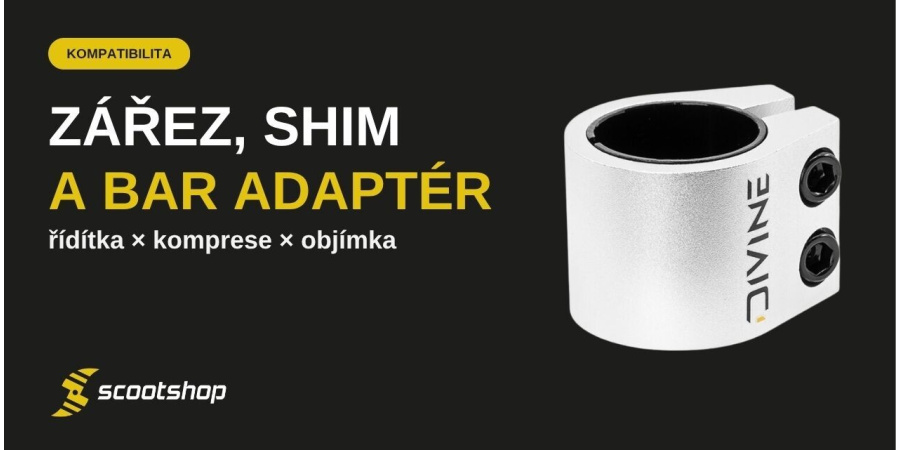
Written by Martin Nogol, Scootshop.cz · Updated on the 14th. 10. 2026
⚡ In short: handlebars need a slit for HIC and IHC.
SCS handlebars must not have it.Shim is a thin metal sleeve that compensates for the difference between standard handlebars (32 mm outer diameter) and an oversized clamp (35 mm). Bar adapter is an insert that lets you use handlebars with a slit on an SCS. The clamp is selected based on the handlebar’s outer diameter, and the handlebar based on its inner diameter where it fits onto the fork.
The tightening sequence is always compression → clamp, with the clamp screws tightened in a crisscross pattern. The notch should face backward toward the rider and be covered by the clamp; if the notch is longer than the clamp, this is not a defect.
✂️ Notch yes / no
HIC, IHC: with a notch. SCS: no notch, otherwise the handlebars will crack.
🧩 Shim 32 → 35
Standard handlebars in an oversized clamp. It never stays in place without a shim.
🔄 Bar adapter
The only way to fit handlebars with a slit onto an SCS.
⚙️ Compression → sleeve
Always in this order, tighten the clamp screws in a cross pattern.
🚫 35/32 on IHC
Oversized steel handlebars are not compatible with IHC.
Not even with an adapter.The three parts that hold the front of the scooter together must match one another. Fork determines the compression system (SCS, HIC, or IHC; the older ICS system is no longer used). Handlebars are fitted onto the fork, so their inner diameter must match the fork steerer tube. The clamp grips the handlebars from the outside, so its inner diameter must match the outer diameter of the handlebars. Compression then defines the play in the headset (the bearings in which the fork rotates).
Handlebars are available in three size classes. We round the numbers; in product descriptions, you may sometimes come across more precise values, but they mean the same thing:
This article addresses only this triangle. You can find an overview of all parts (wheels, brakes, headsets) in the pillar Freestyle Scooter Part Compatibility: What Fits What.
A slit (or slot) is a lengthwise cutout at the lower end of the handlebars, several centimeters long. Its purpose is simple: in HIC and IHC systems, the handlebars are secured to the scooter by the clamp, which tightens them directly onto the fork steerer tube. The tube couldn’t be tightened without a cutout; with the notch, it clamps by a few tenths of a millimeter and grips the post firmly.
At SCS, it works differently. An SCS clamp is a large part with four bolts, into which the fork is inserted from below and the handlebars from above; the clamp holds each of them separately, and the compression system is inside it. So the handlebars are not clamped onto the fork, but sit in the clamp. The notch would serve no purpose here and would also be harmful: the clamp would compress it, the pipe would deform at that point and eventually crack. That’s why handlebars without a slit are bought for SCS.
Notch orientation. The notch should face backward, toward the rider; on some handlebars it is on the side, which is also fine if that is how the manufacturer intended it. It is more important that it is under the clamp. The clamp should cover the notch, because the uncovered part of the notch is a weak point. However, manufacturers often make the slot longer than the clamp so that the handlebars (especially children’s handlebars) can be tightened more easily. So if a small part of the notch sticks out above the sleeve, it is not a defect. Just move the sleeve up as high as possible so that it covers as much as possible.
💡 Cut the notch yourself?
Not recommended. A notch cut at home is often crooked, has sharp corners from which cracks can spread, and voids the warranty. If you have handlebars without a slit and need them for HIC or IHC, the right solution is to buy handlebars with a slit. Conversely (the notch is removed because of SCS), the bar adapter solves it.
A shim is a thin metal insert in the shape of a split tube that compensates for the difference between two diameters. In practice, you’ll encounter two different parts called shims:
When a shim won't help. The shim only addresses the difference between the handlebars and the clamp on the outside. It doesn’t account for the difference between handlebars and forks on the inside: if the handlebars have an inner diameter of 32 mm and the fork uses IHC (a narrower steerer for an inner diameter of 28 mm), no shim will connect them reliably. Oversized 35/32 steel handlebars do not belong on an IHC fork.
A bar adapter (SCS adapter, sometimes called a “sleeve”) is an insert used when you have slit handlebars and an SCS clamp. It is fitted to the underside of the handlebars and fills the slot so that the clamp cannot compress it. Many HIC/IHC handlebars come with an adapter included, because the manufacturer expects someone to use them with SCS. A bar adapter is the only proper way to connect handlebars with a slit to an SCS; cutting off the slit shortens the handlebars and voids the warranty.
Shims, adapters, and compression parts can be found in the compression and shims category, standard clamps in the clamps category, and SCS clamps in the SCS category.
A clamp is a clamp that holds the handlebars on the fork. It is selected based on two things:
The number of clamp screws (2, 3, or 4) is not important. For handlebars with a slot, the clamp should cover as much of the slot as possible. Category clamps.
Always compression first, then the sleeve. Compression (the bolt under the cap at the top of the handlebars, inside the clamp on SCS systems) takes up headset play; tighten it a quarter turn at a time and find the sweet spot: the handlebars should have no play when rocked back and forth, but should still turn completely smoothly. Don’t overdo it. Only then align the handlebars with the front wheel and tighten the clamp: tighten the bolts gradually in a cross pattern (alternate between the two bolts, or, with four bolts, in the order 1, 3, 2, 4), a little at a time, until they are all equally tight.
If you tighten the clamp first, you’ll lock the handlebars and fork in a position with play, and the compression bolt won’t be able to adjust it afterward. The scooter keeps knocking, no matter how much you tighten it. A detailed procedure for each system is in the article How to Tighten the Compression and Handlebars.
Find your handlebars in the row and your compression (according to the fork) in the column.
| 📐 Handlebars | SCS | HIC | IHC |
| Standard steel 32/28 | ✅ No slit. Standard SCS clamp 32 mm, or oversized SCS 35 mm + 32 → 35 shim. With notch only with bar adapter. | ❌ DOESN'T WORK. The 28 mm inner diameter does not fit an HIC steerer tube with a shim (which is for 32 mm). | ✅ With a notch. 32 mm clamp. Most common combinations for sets. |
| Oversized steel / titanium 35/32 | ✅ No notch. Oversized SCS clamp, 35 mm. With notch only with bar adapter. | ✅ With a notch. HIC shim for a fork, 35 mm clamp. This is the combination HIC was created for. | ❌ DOESN'T WORK. Never, not even with an adapter. The IHC bar is for an inner diameter of 28 mm. |
| Aluminum 35/28 | ✅ No notch. Oversized SCS clamp, 35 mm. With notch only with bar adapter. | ❌ DOESN'T WORK. The 28 mm inner diameter does not fit the HIC tube with a shim. | ✅ With a notch. 35 mm clamp (oversized) No shim. |
The old ICS system (a bolt underneath the fork, handlebars with an inner diameter of 28 mm, and a star nut inside) is no longer used today; you’ll only find it on old scooters. A shortcut for parents: IHC = bars with a 28 mm inner diameter only (standard steel or aluminum). HIC = oversized steel 35/32 only. SCS = any, but without a notch. The guide How to Choose Handlebars covers choosing specific handlebars (height, width, material), and How to Choose Compression Systems covers all systems.
So that the sleeve can be tightened onto the fork stanchion. It is needed by the HIC and IHC systems. With SCS, the clamp alone holds the handlebars, so there must not be a slit there.
No. Manufacturers make the slot longer than the clamp so the handlebars can be tightened more easily. Ideally, the notch should be entirely beneath the clamp, so move the clamp as high as possible. If just a little bit is sticking out, that's fine.
Shim 32 → 35 mm. It is installed on the handlebars under the clamp to compensate for the difference in diameters. It is often included in the packaging with an oversized socket.
Only with a bar adapter that fills the notch. Without it, the clamp will compress the notch and the handlebars will crack. Handlebars without a slit are ideal for SCS.
No. Oversized steel handlebars 35/32 do not fit IHC, even with an adapter. Only handlebars with an inner diameter of 28 mm fit IHC: standard steel 32/28 or aluminum 35/28.
It is not important. An SCS clamp usually has 4, while a standard clamp for HIC/IHC has 2 or 3; the important thing is the inner diameter and that it covers the slit.
Send us a photo of the clamp and handlebars, or visit our store in Pardubice; we’ll check whether they’re compatible and fit the parts for you straight away, even if you bought the scooter elsewhere. You can find handlebars in the freestyle scooter handlebars category, and more guides in the Guides section.