Trampoline and snow scooters: what are they and why aren’t they freestyle scooters?
21. October
Entire article
Written by Martin Nogol, Scootshop.cz · Updated on the 14th. 10. 2026
⚡ In short: choose the clamp based on the outer diameter of the handlebars. Either 32 mm or 35 mm.
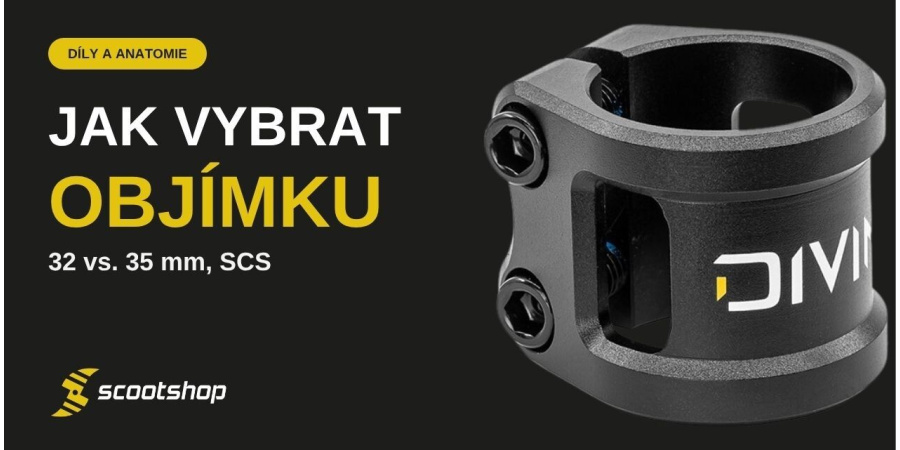
The clamp secures the handlebars around the fork steerer tube to prevent them from rotating.
Standard steel handlebars are 32 mm and fit a 32 mm clamp; oversized steel and aluminum handlebars are 35 mm and fit a 35 mm clamp. A 35 mm clamp can also be used with 32 mm handlebars using a reducer (shim), which is usually included. Don't worry about the number of screws.The exception is the SCS clamp: it is both a compression system and a clamp, and it only fits an SCS/HIC fork with handlebars that have no slit. For each clamp, tighten in the order compression → clamp, with the screws in a cross pattern.
📐 By handlebar
Inner clamp diameter = handlebar outer diameter. 32 or 35 mm.
🧩 Shim = adapter
Thin shim that allows a 35 mm clamp to fit 32 mm handlebars.
🔩 Don’t worry about the screws
2, 3 or 4 screws. It doesn’t determine the selection; tightness provides the strength.
🅰️ SCS = sleeve + compression
Only for SCS/HIC forks, handlebars without a slit (or with a bar adapter).
🔧 Compression → socket
Always in this order. Tighten the clamp bolts evenly, in a cross pattern.
A clamp is a metal ring with two to four bolts that sits at the bottom of the handlebars. The handlebars are fitted onto the fork steerer and have a slot at the bottom; the clamp tightens around the slot, preventing them from rotating on the steerer or moving up and down. It is the only part that holds the handlebars to the fork.
However, the clamp does not eliminate play in the headset. Compression is adjusted here (compression screw in the fork). That’s why you should always tighten the compression bolt first and the clamp afterward: if you tighten the clamp first, it locks the handlebars onto the fork, leaving the compression bolt with nothing left to tighten. You can find an explanation of the entire system in the article SCS, HIC and IHC Compression Systems.
The only exception is the SCS clamp, in which the compression and clamp are a single part. We cover this in a separate section below.
The only dimension you need to consider when choosing a standard socket is its inner diameter. It must match the outer diameter of the handlebars at the bottom, where the clamp sits:
If you’re not sure what type of handlebars you have, check their description or measure the outer diameter of the lower tube with calipers: about 32 mm = standard, about 35 mm = oversized or aluminium. We discuss handlebar diameters and types in the article How to Choose Handlebars.
The number of screws (2, 3, or 4) does not affect the selection.
Lighter clamps have two bolts, while sturdier ones have three or four; they all hold securely if tightened properly. Don't make a big deal out of it.💡 Socket and notch
Ideally, the entire notch in the handlebars should be covered by the clamp; this will make the handlebars last the longest.
However, manufacturers often make it longer than the socket so children can tighten it more easily; this is not a defect. Turn the notch backward, toward the rider (it is sometimes also made from the side). When the fork steerer extends above the end of the slot, the clamp can be lower than the slot; the steerer beneath it will support the handlebars. In detail in the article Handlebars × compression × clamp: slit, shim, and bar adapter.An SCS clamp is a tall clamp with two openings stacked on top of each other: the lower section tightens around the fork steerer tube, while the upper section holds the handlebars.
A compression bolt with a washer goes into it from above; it screws into the thread in the fork and tightens the headset. The compression fitting and the sleeve are therefore one piece. It’s the strongest but also the heaviest solution; the handlebars are shortened by the height of the clamp, which you then effectively “get back” because the handlebars sit above the fork, not on it.You can find SCS clamps in the SCS category. For a child or beginner with a complete scooter featuring IHC, there’s no reason to switch to SCS; it makes sense for heavier riders and street riding.
Handlebar diameters are given as outer / inner in mm.
| 🪢 Handlebars | 🔩 Compression | ⭕ Clamp | 🧩 Shim / adapter |
| Standard steel 32/28 with a slit | IHC | Standard 32 mm, or standard 35 mm | In a 35 mm clamp, use a 35→32 shim |
| Aluminum 35/28 with a slit | IHC | Standard 35 mm | None |
| Oversized steel/titanium 35/32 with a slit | HIC | Standard 35 mm | None (the HIC shim is part of the compression, not clamps) |
| Standard 32 mm without notch | SCS | SCS 32 mm, or SCS 35 mm | In SCS 35 mm shim 35→32 |
| Oversized or 35 mm aluminum without a slit | SCS | SCS 35 mm | None |
| Any bar with a slit for SCS | SCS | SCS according to the outer diameter | Bar adapter (fills the slit), for 32 mm handlebars, an additional shim |
Standard clamps can be found in the clamps category, shims in the HIC, IHC, shimy.
All you need is an Allen key, usually 5 or 6 mm. You can find detailed instructions for all systems in the article How to Tighten the Compression Plug and Handlebars.
💡 When to replace a clamp
A clamp is a part that lasts for years and only needs replacing if it is damaged: a stripped thread (the bolt spins without tightening), a crack in the clamp body (typically around the bolt holes), or deformation after a fall that prevents it from gripping the handlebars evenly.
If the handlebars still rotate with the clamp tightened, first check whether a shim is missing or whether the fork steerer extends above the clamp; only then replace the clamp.Standard 35 mm clamp without a shim. The aluminum handlebars have an outer diameter of 35 mm (and an inner diameter of 28 mm, so they fit an IHC fork).
A 32 mm clamp, or a 35 mm clamp with a shim. A shim is usually included with the 35 mm clamp, making the 35 mm clamp more versatile if you plan to change your handlebars in the future.
It doesn't matter which one you choose. Four-bolt clamps usually have an SCS, while regular ones have two or three. The strength comes from tightening the bolts correctly in a cross pattern, not from the number of bolts.
A thin metal insert that reduces the inner diameter of the sleeve from 35 to 32 mm. You need it whenever you fit standard 32 mm handlebars into a 35 mm clamp or 35 mm SCS.
Most often, the shim is missing (a 35 mm shim on 32 mm handlebars), the slot is facing away from the clamp, or the fork steerer ends well below the clamp, leaving the clamp with nothing to grip. Check these three things before replacing the socket.
No. SCS requires an SCS/HIC fork with a thicker steerer tube and handlebars without a slit. For the IHC set, stick with the standard socket; it is perfectly adequate for a child.
Send us a message or bring your scooter to our store in Pardubice; we’ll select the clamp and adjust the handlebars on the spot, even if you bought the scooter elsewhere. You can find the parts in the clamps, HIC, IHC, and ICS shims, and SCS categories. Related articles: Compression systems, How to choose handlebars, How to choose a fork, How to choose a deck, and Headset. Another guide in the Guides section.