Trampoline and snow scooters: what are they and why aren’t they freestyle scooters?
21. October
Entire article
Written by Martin Nogol, Scootshop.cz · Updated on the 14th. 10. 2026
⚡ In short: a beginner doesn’t worry about style; they buy an all-purpose set.
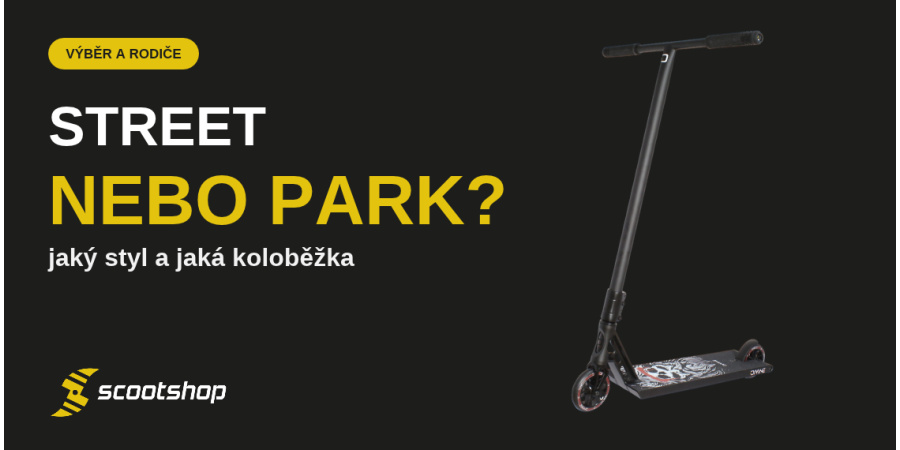
Park = skatepark, ramps, jumps in the air. It comes with a lighter scooter, a shorter and narrower deck, 110 mm wheels, and lower handlebars. Street = street, railings, stairs and grinds. It comes with a sturdier, heavier setup, a longer and wider deck, pegs, and taller handlebars.
You’ll know where your child is heading after the first season, based on what they enjoy. In the meantime, a standard setup for CZK 2,000–4,000 that can handle both will do.
🛹 Park = air
Ramps, jumps, rotations. Lightweight scooter, shorter deck, lower handlebars.
🏙️ Street = grindy
Railings, stairs, curbs. Solid, heavier scooter, pegs, taller handlebars.
🛞 110 mm everywhere
A standard for both park and street.
120 mm is hardly ever used in the park because of its weight.🧒 A beginner doesn’t worry about
The versatile set handles both.
Style only shows after the season.🚫 Pegs not right away
For a beginner, they are an unnecessary extra burden. They’ll come with their first grinds.
Park (park riding) is riding in a skatepark: on ramps, in bowls, over boxes and jumps. The rider picks up speed on the ramp and launches into the air (this is called an air), performing tricks midair: spinning the handlebars (barspin), whipping the deck around beneath them (tailwhip), or rotating their whole body (360). Then it falls back onto the ramp. The key is for the scooter to be light and responsive, because the rider is constantly lifting and turning it in the air.
Typical park setup:
Most children in the Czech Republic start out at a skatepark, because it is safer and easier to navigate than the street. That’s why kids’ setups are usually geared toward the skate park: lightweight, with 110 mm wheels and no pegs.
Street riding is riding around the city, on railings, curbs, stairs, benches, and walls. The main discipline is grinding, where the rider slides along a railing or edge on the underside of the board, or on pegs (metal tubes on the wheel axles). This includes jumps down stairs and landings on hard concrete. A street scooter needs to withstand a lot: impacts are harder, and rail edges grind down the deck and pegs.
Typical street setup:
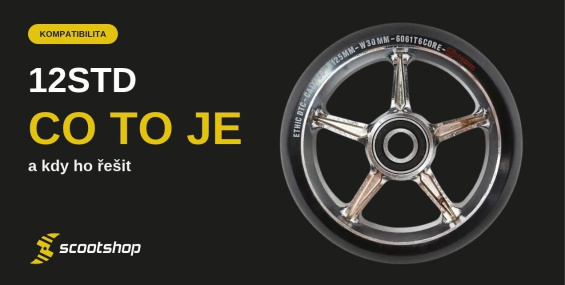
💡 12STD standard only marginally
Among street riders, you may occasionally come across the abbreviation 12STD. It’s a standard with a 12 mm axle and different bearings, used mainly by the Ethic brand and ridden by professionals in France, for example. It has not caught on in the Czech Republic, and it is being phased out. When choosing a children’s scooter, don’t worry about it; when buying replacement wheels, stick to the standard 8 mm axle with 608 bearings.
Street usually comes after a few seasons in the park, once the rider can jump and wants to ride ledges and rails. Younger children rarely want a street scooter, and when they do, it’s usually because they’ve seen it in videos.
A hybrid is what you get in a standard beginner’s setup: a medium-sized deck, 110 mm wheels, and handlebars of medium height. You can ride it in the park and try your first grinds on a curb.
| 🛹 Park | 🏙️ Street | 🧒 All-round (complete) | |
| Where you ride | Skatepark, ramps, boxes | Street, railing, stairs | Both, mainly skatepark |
| Main tricks | Airs, whips Air rotation | Grinds, jumps down the stairs, manuals | Basics: bunny hop, first jumps |
| Board | Shorter and narrower (approx. 4,5–5"), angled end | Longer and wider (approx. 5–6"), square end | Medium, based on the rider’s height |
| Wheels | 110 mm × 24 mm | 110 mm, for taller riders, even 120 mm | 110 mm (100 mm for the smallest children) |
| Handlebars | Lower, often aluminum | Higher, mostly steel | Navel to waist, steel or aluminum |
| Compression | IHC, HIC (mild) | SCS, HIC (firmer) | Most commonly IHC |
| Pegboards | No | Yes | No, will be purchased later |
| Weight | As low as possible | Higher, strength takes priority | Approx. 3–4 kg |
| Who it’s for | Riders, who want to fly | Advanced, older and heavier riders | Beginners and first seasons |
The division is a general rule, not dogma. Individual riders fine-tune their setups to suit their preferences, and many advanced riders use a “park setup” on the street too.
A beginner spends the first year learning to stand on a scooter, push off, brake, do a bunny hop, and ride down their first ramp. All of this is the same for park and street, and any decent setup can handle it. The differences between park and street setups only start to matter when a rider is doing tricks where a few hundred grams or a centimeter of deck width makes a difference. That’s a question for the second or third season.
Practical tip: choose the set based on your child's height and price, not style. A guide explains how to do it: How to Choose a Freestyle Scooter. A good starter set costs CZK 2,000–3,000 for younger children and CZK 2,500–4,000 for older children.
The advantage of a freestyle scooter is that it’s a build-it-yourself kit. If, after a year, it turns out that your child wants to ride on the railing, you can buy pegs and, if necessary, stronger handlebars. If you want to ride in the park, replace the handlebars with lighter, lower ones. You don't have to buy a new scooter.
You don’t need to ask; just watch what the child does when you let them ride on their own:
💡 Example: 12 years old, 150 cm, two seasons at the park
The boy rides a versatile setup, can do tailwhips, and has started trying grinds on the curb. A new scooter isn’t necessary: just buy some pegs and get slightly taller steel handlebars the next time you replace them. If he gets tired of grinding next season and returns to the ramps, he can simply take the pegs off.
The Park model is lighter, with a shorter and narrower deck, lower handlebars, and no pegs. Street scooters are sturdier and heavier, with a longer and wider deck, higher handlebars, and pegs for grinds. Both wheels are most commonly 110 mm.
Universal set based on the child's height. Don't worry about your riding style; it will only become apparent after the first season. You can then buy additional pieces based on what your child enjoys.
Yes, partially. You can add pegs and taller steel handlebars. The board remains, and if it is too narrow or short to absorb impacts, it is changed only as a last resort. When replacing the handlebars, be careful with the compression system; see the guide Compression Systems Guide.
Neither is universally better. They are faster and more stable, but heavier, so they are rarely used in the park. They make more sense on the street and for taller riders. Whether they fit your fork and deck always depends on the specific product.
Pegs are metal tubes on the wheel axles that you grind along rails. Beginners don't need them; they only add weight, and they’re generally becoming obsolete. They’re purchased only when the rider starts trying their first grinds.
An alternative standard with a 12 mm axle and different bearings, used mainly by Ethic and ridden on the streets in France. It didn’t catch on in Czechia. The standard is an 8 mm axle and 608 bearings.
Write to us or visit our store in Pardubice. We’ll talk with your child about what they enjoy and choose a scooter or custom parts. You can find complete scooters in the freestyle scooters category, parts in the freestyle scooter parts category, and more guides in the Guides section.