Trampoline and snow scooters: what are they and why aren’t they freestyle scooters?
21. October
Entire article

Written by Martin Nogol, Scootshop.cz · Updated on the 14th. 10. 2026
⚡ In brief: 85 terms you’ll hear at the skatepark, on an e-shop, and from your own child.
Parts (deck, fork, headset, clamp, grips), standards (SCS, HIC, IHC, 608, ABEC), tricks (tailwhip, barspin, bunny hop, grind), styles (park, street, flatland), materials, and safety. Each entry in bold, followed by the English term in parentheses, then 1–3 sentences.
To see how the parts fit together, read the article What a Freestyle Scooter Is Made Of. How to choose the right scooter, in our guide How to Choose a Freestyle Scooter.
🔩 SCS / HIC / IHC
Three compression systems (and the historical ICS).
The most important abbreviations that determine what fits your scooter.✅ Dialed
A scooter with no play or rattling.
The purpose of every post-ride check.🌀 Whip a barspin
Two basic tricks: a board spin and a handlebar spin.
⚙️ ABEC ≠ durability
The number indicates the manufacturing precision of the bearing, not how long it will last.
🪖 EN 1078
Standard for bicycle, skateboarding, and roller skating helmets. Look for it on the label.
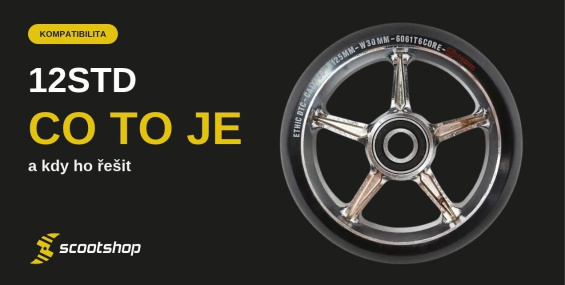
12STD (12 mm standard) – a hub standard with a 12 mm axle and larger 6001 bearings instead of the usual 608 bearings. It is mainly used by Ethic; for example, it is ridden by Professionals in France use it in street dancing; it is not widespread in the Czech Republic and is being phased out. 12STD parts are not compatible with standard 8 mm axles without reducers.
180 / 360 (one-eighty, three-sixty) – a half-turn (180°) or a full turn (360°) in the air, with the rider and scooter rotating together.
After 180, the rider lands and rides backward (fakie).608 – designation of the standard wheel bearing; see the entry “608 Bearing.”
ABEC – bearing manufacturing precision scale, odd numbers only: 1, 3, 5, 7, 9. A higher number means more precise manufacturing, not longer durability or higher quality. Some good brands don't list an ABEC rating at all.
Air (air, airtrick) – a jump in which the rider and scooter are both airborne, usually off a ramp or quarter pipe. The basis of all aerial tricks.
Backsweep – the angle at which the handlebar grips are bent backward toward the rider. Typical for Y-shaped handlebars, more comfortable on the wrists.
Bar ends, bar plugs (bar ends, bar plugs) – plugs in the ends of the handlebars. Protects hands from the sharp edge of the pipe in the event of a fall, protects the park surface, and holds the grips in place. An essential part of the handlebars, not an accessory.
Barspin – a trick in which the rider spins the handlebars 360° in mid-air and catches them again.
Requires a smoothly rotating headset and properly adjusted compression.Boxed board (boxed deck, boxed end) – a board with a squared-off closed end. Typical for street riding, it better resists aluminum bending on edge impacts. The opposite is an obliquely cut end; see Peg-cut.
Brake (brake) – a metal plate above the rear wheel that is pressed down with the heel. A freestyle scooter does not have a hand brake. Nowadays, it’s almost always a flex fender; the spring type is an older design found on inexpensive scooters. It never brakes by locking the wheel; that causes flat spots.
Bunny hop (bunny hop, hop) – a basic jump from a standstill or while riding, without a ramp: the rider pulls up on the handlebars, pushes off, and jumps with the scooter.
The first trick everyone learns.Butted tube (butted tubing) – a handlebar tube with a thinner wall in the middle and thicker walls at the ends. Saves weight where strength isn’t needed.
Chromoly (chromoly, cr-mo) – chromium-molybdenum steel used for handlebars and pegs. Strong, inexpensive, and heavier than aluminum. Allows a clean T-shape without reinforcements. Available for every compression system.
Concave – the board’s standing surface is curved into a slight channel across its width. Helps you feel the edge of the board with your feet. It's good to have one; a board with a concave shape keeps your feet in place better.
C-ring, compression ring (compression ring) – a ring in the headset around the fork steerer tube that takes up play and is pressed by the compression system.
The IHC is narrower (mini C-ring) because of the fork’s thinner steerer tube.Custom (custom build) – a scooter assembled from individually selected parts instead of a ready-made complete.
It makes sense for experienced riders who know what they want from every component. It costs beginners more than the complete set.Deck – the scooter’s load-bearing frame, made from a single piece of aluminum. At the front, it has a head tube for the fork; at the rear, it holds the rear wheel and brake. Width (park narrower, street wider), length, end shape, and head tube angle are distinguished. Category: decks.
Dialed – a scooter with no play or rattling: the compression and clamp are tightened, the axles are secure, and nothing rattles.
“Dialing” means tuning a scooter like this. Verified by a drop test.Drop-in – entering a ramp or quarter pipe from above: the rider places the scooter on the edge and drops in. The first “spooky” step in the park.
Drop test – post-ride test: lift the scooter a few centimeters off the ground and let it drop onto its wheels.
A dull sound is fine; sharp knocking means something has come loose (compression, clamp, or axle).Durometer (durometer) – the hardness scale of polyurethane wheels, measured in degrees A (e.g. 86A). Freestyle wheels are usually 85–88A. A harder wheel is faster and more durable, while a softer one offers better grip and cushioning.
EN 1078 – European standard for helmets for cyclists, skateboarders, and roller skaters. Look for this standard on the label of a freestyle scooter helmet. For the youngest children, a derived EN 1080 standard exists. Category: helmets.
EN 14619 – European standard for human-powered scooters for users weighing 20–100 kg. A scooter bearing this label has passed strength tests as sports equipment, not as a toy.
Fakie – riding backwards, usually after landing from a 180.
The rider is standing normally, but the scooter is moving backwards.Fender (fender, mudguard) – a fixed mudguard above the rear wheel that does not brake.
Some street riders use it instead of a brake because it’s sturdy and leaves more room for their foot.Flat (flatland) – a riding style on a flat surface without ramps or obstacles; tricks are performed using bunny hops and manuals. A good way to learn at home in the parking lot.
Flex fender – the most common type of brake: a long, pre-bent metal plate screwed to the deck that bends down onto the wheel when pressed.
Quiet and simple; over time, it cracks, especially above a worn wheel. Category: brakes.Foot space (foot room) – the usable length of the deck’s standing area between the neck and the brake.
A more important figure than the overall length of the board.Funbox – an obstacle in a skatepark: a platform with ramps on multiple sides, often with a rail or ledge on top. A versatile feature for jumps and grinds.
Grind – riding along an edge or railing on the pegs or the underside of the deck instead of on the wheels.
It is one of the more advanced tricks and usually requires pegs.Griptape (grip tape) – self-adhesive non-slip “sandpaper” on the deck. Consumable part, replaced every few months or when it no longer holds. It damages regular sneakers, which is why people skate in skate shoes.
Grips (grips) – rubber handles on the handlebars; softer rubber absorbs more vibration, while harder rubber lasts longer.
Most frequently replaced part: they are replaced when they become sticky, torn, or worn through. They are applied with a little hairspray or alcohol.Gusset (reinforcement) – a triangular reinforcement at the handlebar joint.
Typical of Y-shaped aluminum handlebars, where it reinforces the less durable material.Headset – two bearings in the deck’s head tube that the fork rotates in. Without it, the handlebars couldn't be turned. Today, only integrated ones are sold. Category: headsets.
Headtube, head tube – the tube at the front of the deck through which the fork passes. Its angle (typically 82–84°) determines how much the handlebars point toward the rider and how quickly the scooter turns.
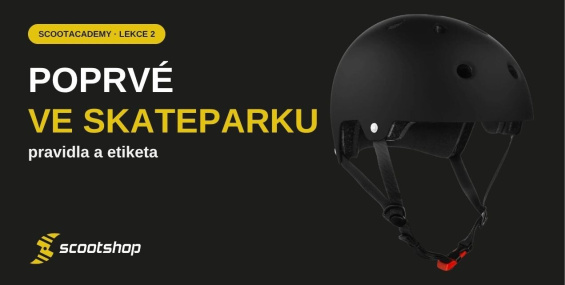
Helmet – we strongly recommend wearing one at all times, for both children and adults, on the street and at the skatepark; falls onto the head are the most common among beginners. Choose a skate model with a hard shell that complies with EN 1078.
HIC (Hidden Internal Compression) – a compression system in which a shim is placed on the fork steerer tube and a compression bolt with a cap compresses it from above.
Requires oversized steel or titanium handlebars with a slot and an oversized clamp. Lighter than SCS. Guide: How Compression Systems Work.Aluminum (aluminium alloy) – aluminum alloys for decks, forks and handlebars. Lightweight and stiff, but less durable than steel, so handlebars are reinforced (with a gusset, Y-shape).
Protective gear (pads) – knee, elbow and wrist guards.
Best suited for beginners in the first few months, when the child is learning to fall. Category: protective gear.Mouthguard (mouthguard) – a soft protective device worn in the mouth, like the ones hockey players wear. In the event of a fall onto the handlebars, it protects the teeth and lips. For freestyle scooters, they’re worn less often than helmets, but they make sense for more advanced tricks.
ICS (Inverted Compression System) – a historical compression system that is no longer used today; you’ll only find it on old scooters. The bolt passes through the fork from below and screws upward into the handlebars (28 mm internal diameter). The front wheel must be removed to tighten it. The ICS10 variant has a stronger screw. ICS forks are not compatible with other systems.
IHC (Internal Hidden Compression) – like HIC, but the fork has a narrower steerer tube, so it fits standard handlebars with an inner diameter of 28 mm. The lightest and most common system in beginner sets. Parts: HIC, IHC, ICS compression.
Integrated headset (integrated headset) – a headset whose bearing cups are built directly into the deck’s head tube; the bearings are simply inserted.
Today, only integrated headsets are sold; you can identify an integrated headset by its machined head tube, into which the bearing fits directly. The non-integrated headset (separate cups pressed into the frame’s head tube) is a thing of the past and belongs to the budget segment.Wheel core – the solid center of the wheel onto which polyurethane is poured. Full (full/solid core) is the strongest and heaviest; spoked (with spoke-like cutouts) is lighter; hollow (hollow) is lightweight, but not as strong. An aluminum core is essential for tricks; plastic ones bend on impact.
Wheel (wheel) – core + polyurethane tread. Diameter is given (110 mm standard, 100 mm for the smallest, 120 mm for advanced riders), along with width (24 mm standard, 30 mm street) and hardness (85–88A). Category: wheels.
Complete scooter (complete, complete scooter) – a ready-to-ride scooter, matched by the manufacturer.
The right choice for beginners; it costs less than buying the same parts separately. Category: freestyle scooters.Compression, compression system (compression) – a method of drawing the handlebars, headset, and fork together so there is no play in the steering, while still allowing the handlebars to turn freely.
Three systems: SCS, HIC, IHC (and the historical ICS). The fork determines the type; the handlebars and clamp are selected to match it. It is always tightened before the clamp, to the “sweet spot”: no play, but not cranked down too tight.Ledge – a low edge (curb, bench, concrete block) that you grind on. The simplest obstacle for your first grinds.
608 bearing (608 bearing) – a standard wheel bearing for an 8 mm axle, the same as those used on skateboards and skates. Each wheel has two; a scooter has four. They are sold in sets of 4 (2 per wheel + spacer). Replace it if it crunches or doesn’t spin. Water and sand destroy it; WD-40 is not a lubricant. Category: bearings, guide How to choose bearings.
Manual (manual, wheelie) – riding only on the rear wheel with the front lifted off the ground, without jumping.
A nose manual is the same as a manual over the front wheel. It teaches balance and can be practiced anywhere.Load capacity (max rider weight) – the maximum rider weight specified by the manufacturer, usually around 100 kg for complete setups.
Upon impact, a force of 2–3 times the rider’s weight acts on the scooter, so heavier riders need stronger components.Clamp – an aluminum ring with 2–4 bolts that secures the handlebars around the fork steerer tube.
Inner diameter 32 mm (standard) or 35 mm (oversized). In SCS, the sleeve also serves as the compression fitting. Tighten the screws in a crisscross pattern, only after tightening the compression.Fork offset (rake) – the distance in mm between the front wheel axle and the steering axis. Most commonly 10 mm (stable, predictable handling). Zero offset has the wheel closer to the rider, making it more agile and easier to nose manual.
8 mm axle – a strong bolt that passes through the fork or plate and the wheel bearings.
8 mm is the standard size for 608 bearings. It must always be tightened all the way; a loose axle is the most common cause of knocking.Oversized – a larger handlebar diameter class: 35 mm outer diameter, 32 mm inner diameter. Firmer and heavier than standard. Requires an oversized clamp. Aluminum handlebars often have a “mix” of 35 mm outer / 28 mm inner diameter.
Park (park riding) – a riding style in a skatepark: ramps, quarter pipes, jumps, spins, and whips in the air. Park scooters are lighter, with a narrower deck and lower handlebars.
Peg (peg) – a metal tube screwed onto the side of a wheel axle. Used for grinding along rails and edges. Not all pegs fit all boards. Beginners don’t need them, and they’re generally becoming obsolete.
Peg-cut, angle cut – an angled end cut on a board, typical of park boards. Repeat boxed ends.
Flat spot – a flattened, worn patch on a wheel caused by the wheel locking up under braking.
The wheel then rattles. It cannot be repaired, only replaced, and the manufacturer does not recognize it as a defect.PU, polyurethane – the material used for the wheels’ tread. Its hardness is measured with a durometer in Shore A units. When the PU peels away from the core, the wheel changes.
Quarter (quarterpipe) – a quarter-circle-shaped ramp with a platform at the top. A basic skatepark feature for airs and drop-ins.
Rail (rail, handrail) – a metal pipe or railing that you grind on with your pegs. More difficult than a ledge because it is narrow and rounded.
Handlebars (bar, bars, handlebar) – a T- or Y-shaped tube that determines the height of the scooter. They are selected according to height (from the navel to the waist when the rider is standing on the board), diameters (standard 32/28 mm, oversized 35/32 mm, aluminum 35/28 mm), the cutout, and material. People also search for the form “řidítka.” Category: handlebars, guide How to choose handlebars.
SCS (Standard Compression System) – a compression system where the compression mechanism is part of a clamp with four bolts.
The strongest and heaviest. Handlebars for SCS must not have a slit, or they will crack; handlebars with a slit can be used with an SCS adapter. Category: SCS.Setup – the collection of parts a rider rides: “my setup is deck X, handlebars Y, wheels Z”. Used for both complete and custom.
Shim (shim, reducer) – a thin insert that compensates for the difference in diameters. With HIC, it is fitted onto the fork steerer tube; with the clamps, it reduces the oversized diameter (35 mm) to the standard size (32 mm). Many oversized clamps come with it in the package.
Spacer (spacer) – a metal insert between two bearings inside a wheel, preventing them from being compressed together when the axle is tightened.
Additional spacers fill the space in the fork or plate when the wheel is narrower than the cutout. Use spacers designed for your board.Stall – stopping on the edge of an obstacle (on the pegs, deck, or wheel) and bouncing back.
Precursor to grinds.Standard (handlebars) (standard bars) – basic handlebar size class: outer diameter 32 mm, inner diameter 28 mm.
Lighter and less structured than oversized. They fit IHC and SCS (with a standard clamp), not HIC.Star nut (star nut, hedgehog) – a historical component: a toothed nut driven into the steerer tube, into which the compression bolt was threaded on old forks.
Today's HIC and SCS forks have a built-in thread in the steerer tube, so you no longer need a star nut.Street (street riding) – a riding style involving streets and urban obstacles: stairs, railings, curbs, grinds, and drops. Street scooters are heavier, with a wider deck, pegs, and often taller handlebars.
Tailwhip, whip – a trick in which the rider holds the handlebars in midair while the deck spins 360° beneath them around the fork stem. The most famous scooter trick. Whip impacts put a side load on the wheels.
T-bar – T-shaped handlebars without crossbars. Typically made of steel or titanium. Neither T nor Y is objectively better.
Titanium (titanium) – handlebar material: as light as aluminum and as strong as steel, but expensive.
Springs. If it fails, it doesn’t bend but snaps all at once, so it should be replaced as soon as signs of wear appear.Top cap (top cap, cover cap) – the metal cap at the top of the compression bolt, through which the bolt presses on the headset. For HIC/IHC, it sits above the headset cup. It also protects the headset bearings from dirt (dust cover).
Hardness (A) (hardness, Shore A) – see Durometer. Freestyle wheels are usually 85–88A.
Upsweep – the angle at which the handlebar ends rise upward. Together with the backsweep, typical of Y handlebars.
Fork (fork) – the part that holds the front wheel and passes up through the deck’s head tube to the handlebars.
Specifies the compression system (SCS/HIC/IHC), the maximum wheel diameter (110, 120 mm), and wheel width (24/30 mm). Category: forks.Play (wobble, looseness) – unwanted movement at a joint: the handlebars wobble in the headset, the wheel runs out of true, the clamp rotates.
Test: hold the front wheel between your feet and try turning the handlebars. The play is eliminated by tightening the compression, then the clamp.Handlebar height vs. total height (bar height vs. total height) – handlebar height is measured only at the handlebars themselves, from the bottom of the tube to the top edge. The total height of the scooter from the ground to the top of the handlebars; used to choose a complete scooter. Do not confuse. Table by rider height in the guide How to Choose a Freestyle Scooter.
Y-bar – Y-shaped handlebars with reinforcements at the joint. Typical for aluminum, which needs reinforcement. They usually have backsweep and upsweep.
Slot (slit, slot) – a lengthwise cutout in the underside of the handlebars, allowing the clamp to tighten around the fork steerer tube.
Bars for HIC and IHC must have a slit; bars for SCS must not have one. The notch points backward toward the rider (sometimes from the side). Ideally, it sits entirely beneath the clamp, but manufacturers often make it longer so the handlebars are easier to tighten.Threaded compression (threaded fork, threaded headset) – an outdated system with a threaded steel fork and a nut instead of a compression bolt.
Nowadays, only on the cheapest scooters; heavier and less durable. Incompatible with modern parts.What fits with what (handlebars × compression):
| Standard 32/28 mm | Oversized 35/32 mm | Aluminum 35/28 mm | |
| SCS | Yes, without a notch standard SCS clamp | Yes, without a notch oversized SCS clamp | Yes, without a notch oversized SCS clamp |
| HIC | No | Yes, with a notch | No |
| IHC | Yes, with a notch, standard socket | No, not even with an adapter | Yes, with a notch, oversized clamp |
Slit handlebars can only be used with SCS with an SCS adapter. In detail in the guide How to Use Compression Systems.
These are all compression systems, meaning a way to clamp the handlebars, headset, and fork together. SCS has compression in the clamp and handlebars without a slit. HIC and IHC have a shim and a top bolt; they differ in handlebar diameter. The historical ICS (a bolt underneath the fork) is no longer used. Which system you have is determined by the fork. In detail in the guide How to Use Compression Systems.
That there is no play or knocking in it. You can check this with a drop test: drop the scooter onto its wheels from a few centimeters up and listen. The inspection procedure is described in the guide How to assemble a new freestyle scooter and what to check before your first ride.
Two basic tricks in the air. Whip (tailwhip): The deck rotates 360° beneath the rider, who holds the handlebars. Barspin: the handlebars rotate 360° in the hands of the rider standing on the deck. Both are learning the bunny hop.
Write to us and we’ll add the password. You can find out what each part does and how often it should be replaced in the article What a freestyle scooter is made of , all the parts in the freestyle scooter parts category, and more guides in the Guides section. Or stop by our store in Pardubice.