Trampoline and snow scooters: what are they and why aren’t they freestyle scooters?
21. October
Entire article
Written by Martin Nogol, Scootshop.cz · Updated on the 14th. 10. 2026
⚡ In brief: four things determine what fits with what. Compression system, handlebar diameter, wheel size, and headset type.
The compression type is determined by the fork (SCS, HIC, or IHC), and the handlebars and clamp are selected to match it. The handlebars have two diameters: an outer diameter of 32 or 35 mm (used to select the clamp) and an inner diameter of 28 or 32 mm (used to fit the handlebars onto the fork). Only handlebars with an inner diameter of 28 mm will fit the IHC fork.
The wheel must fit the fork, deck, and brake: 110 × 24 mm is the current standard and fits almost everywhere; always check compatibility with the specific fork and deck for 120 mm wheels and 30 mm-wide wheels. The headset is only sold as an integrated unit today.
⚙️ Fork = system
The fork determines whether you have SCS, HIC, or IHC. The handlebars and clamp are chosen to match it.
📐 Two diameters
Handlebars: outer 32 / 35 mm (clamp), inner 28 / 32 mm (fork).
🛞 110 × 24 mm
Standard wheel. Fits most forks, boards, and under most brakes.
🎯 Integrated headset
Standard for quality boards. You’ll find non-integrated models in cheap sets.
🚫 Oversized at IHC
35/32 handlebars don't work with an IHC fork.
Never, not even with an adapter.A freestyle scooter is a kit. Most parts can be replaced, but not every part fits every other part. The good news: you don’t have to know everything. Just keep an eye on four things.
Below each of these four items, you’ll find a table. If you’re planning to buy just one issue, skip straight to the When I’m buying one issue section.
This is the most important table in the article. First, find out what fork you have (compression system), then read the row.
| ⚙️ System | 🔱 Fork | 📐 Handlebars (outer/inner diameter, slit) | 🔩 Clamp | 🧩 Shim / adapter | 💬 Note |
| SCS | SCS or HIC fork (they are the same; both have a built-in thread in the steerer tube for the compression bolt). | Standard 32/28, oversized 35/32, and aluminum 35/28. Always without a notch. | SCS clamp with 4 bolts, inner diameter according to the handlebars: 32 or 35 mm. | Standard handlebars in oversized SCS: shim 32 → 35 mm. Handlebars with a cutout: only with a bar adapter. | The strongest and heaviest. The compression is part of the sleeve. Sometimes a spacer (headset spacer) is needed so the stem extends above the fork. |
| HIC | HIC or SCS fork (same steerer tube, integrated thread). | Only oversized steel or titanium 35/32 with a notch. Standard 32/28: no; aluminum 35/28: no (they have a narrower interior). | 35 mm clamp (the number of screws is irrelevant). It should cover the notch. | HIC shim: a metal insert fitted onto the fork steerer (usually supplied with the fork or handlebars). | Lighter than SCS, firm. Typical of more advanced setups and custom scooters. |
| IHC | IHC forks only (narrower steerer tube, integrated thread). | Only handlebars with a 28 mm inner diameter and a slot: standard 32/28 steel or 35/28 aluminium. Oversized 35/32 never, not even with an adapter. | 32 mm for standard handlebars, 35 mm for aluminum handlebars. The number of screws is not important. | IHC compression ring for the upper headset bearing (usually included with the fork). No shim for the handlebars. | The lightest and most common option for sets designed for children and beginners. |
| ICS (historical, no longer used) | ICS forks only (the compression bolt runs from the bottom of the fork up into the handlebars). | Inner diameter 28 mm with a notch, outer diameter 32 or 35 mm, with the expander inside the handlebars. | According to the handlebar outer diameter: 32 or 35 mm. | Usually none. | An older system that is no longer used today; you’ll only find it on old scooters. The front wheel must be removed to tighten it. |
💡 What are a notch and a shim
Slit is a longitudinal cutout on the underside of the handlebars. HIC and IHC need it because the clamp secures the handlebars directly to the fork steerer. It must not have one for SCS, as the clamp itself holds the handlebars there and the slit would crack. Shim is a thin metal insert that compensates for the difference in diameters (standard 32 mm handlebars in a 35 mm clamp). We explore this in depth in the article Handlebars × compression × clamp: notch, shim, and bar adapter explained. You can also find the basics of all systems in the guide Compression Systems Guide.
The wheel must pass through three points: the fork (front), the plate (rear, the space between the ends of the plate), and the brake. Each of them has its own maximum diameter; the fork and plate also have a maximum width. You can find the wheel size on its side or in the product description, for example “110 × 24 mm”.
| 🛞 Wheel | 🔱 Fork | 🛹 Deck | 🛑 Brake |
| 100 × 24 mm | Fits every fork. | It needs spacers in a wider fork (30 mm).Fits every board. | Fits under both 100 mm and 110 mm brakes (braking performance is slightly worse with the longer brake). |
| 110 × 24 mm today’s standard | Virtually every modern fork. The exceptions are the cheapest and older complete bikes built around a 100 mm standard. | Practically every motherboard today. For slabs constructed to 100 mm, verify. | Only for a 110 mm brake. It doesn’t fit under a 100 mm brake; it rubs. |
| 110 × 30 mm | Only the fork is specified as 30 mm. It generally won’t fit in a 24 mm fork; check each product individually. | Only the board listed as 30 mm. Generally, no, for a 24 mm board. | Brake for 110 mm, but it must be wide enough; check with the specific board. |
| 120 × 24 mm | Only forks with a stated maximum of 120 mm. Always depending on the specific product. | Only the board with a stated maximum of 120 mm. Always depending on the specific product. | Brake for 120 mm (often included with the board). A 110 mm brake isn’t enough. |
| 120 × 30 mm | 120 mm and 30 mm forks at the same time. Least common combination, by product only. | Board 120 mm and also 30 mm. Based on the product only. | Brake for 120 mm, sufficiently wide. Based on the product only. |
Width rule: a narrower wheel will fit in a wider fork or deck; spacers (rings that the manufacturer often includes) can make up the difference. A wider wheel won’t fit into a narrower fork or plate. Diameter rule: a smaller wheel fits everywhere; a larger one only where the manufacturer explicitly states it does.
Axle: the standard is an 8 mm axle and 608 bearings; this applies to the vast majority of wheels, forks, and decks.
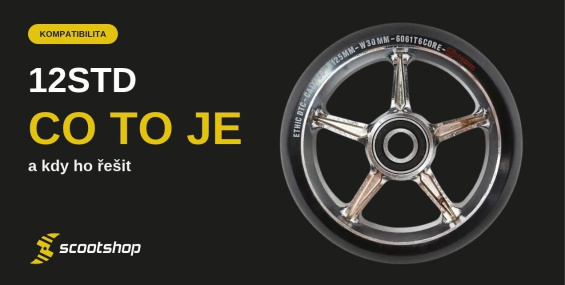
The non-standard 12STD (12 mm axle, different bearings) is used mainly by Ethic; it is not very common in the Czech Republic and is being phased out. The 12STD deck and fork can be fitted with 8 mm wheels using an adapter, but the reverse (12STD wheels on 8 mm parts) is not possible.125 mm wheels are hardly manufactured anymore, and 120 mm wheels are rarely used at the skatepark because of their weight. For a child or beginner, 110 × 24 mm is the obvious choice. We explain how to measure a wheel and when it is worn out in the article Which wheel fits my fork, deck and brake?. Wheel selection in general is covered in the guide How to choose wheels for a freestyle scooter.
The headset consists of two bearings (upper and lower) in which the fork rotates inside the board’s head tube. Today, only integrated headsets are sold: you can recognize an integrated head tube by its machined surface, into which the bearing fits directly. Non-integrated headsets (separate cups pressed into a smooth tube) are a thing of the past and belong to the budget segment.
| 🎯 Headset | 🛹 Which deck | 🔱 Which fork | 💬 Where you'll find it |
| Integrated | Only for decks with an integrated head tube. Quality boards and headsets share the same dimensions, so they fit across brands. | SCS, HIC, and IHC forks (for IHC, an IHC compression ring is added to the upper bearing). | Standard on all quality complete setups and custom scooters. |
| Non-integrated | Only for frames with a smooth head tube without bearing seats. It cannot go into the integrated board, and vice versa. | Depending on the specific kit; often a threaded fork. | Cheap segment, unfortunately still. Spare parts are harder to find. |
In practice: a quality deck and a headset from the specialist range are integrated and will fit. Note: This only applies to cheap complete bikes from chain stores with a non-integrated or threaded headset: the parts are difficult to replace, and it is often more sensible to replace the frame together with the fork.
One part is worn out, damaged, or your child has outgrown it, so you’re buying a replacement. Each part has one or two things to check.
Find out your compression system (based on the fork) and read the table above. Keep an eye on three things: inner diameter (28 mm for IHC, 32 mm for HIC, any size for SCS), outer diameter (32 or 35 mm; the clamp must match it), and the slit (yes for HIC/IHC, no for SCS). Choose a height so that the handlebars reach somewhere between the rider’s navel and waist; learn more in the Handlebar Guide and browse our handlebars category.
The fork determines the compression system, so when you replace it with a different type, you usually also change the handlebars or clamp. Also check the maximum diameter and width of the wheel (e.g. “up to 110 × 24 mm”) and axle type (8 mm standard). The fork must be compatible with an integrated headset, if your frame has one. Category forks.
Clamp inner diameter = handlebar outer diameter (32 or 35 mm). The oversized 35 mm clamp can also be used on standard handlebars by adding a 32 → 35 shim. For SCS, you need an SCS clamp (it includes compression); for HIC/IHC, a standard clamp (the number of bolts does not matter). On handlebars with a notch, the clamp should cover the notch. Category clamps.
Check the diameter and width against the maximum for the fork, deck, and brake (see table above). Buy them in pairs, or at least with the same diameter at the front and rear. The 8 mm axle and 608 bearings are standard; 12STD wheels are only suitable if you have a 12STD fork and deck. Categories wheels and bearings.
The brake must match the wheel diameter (100, 110, or 120 mm) and the hole spacing on the deck. The safest choice is a brake from the same brand as the deck, or a universal brake with verified compatibility. Today, flex fenders (flexible metal plates) are used; spring brakes are found only on old and cheapest scooters. Category brakes.
Today, only integrated (into the frame with a machined head tube). With an IHC fork, you also need an IHC compression ring (usually included with the fork). With SCS, sometimes use a spacer so the clamp extends above the fork.
Grips (rubber handles) are universal and fit all freestyle handlebars as well as BMX bikes. You don't need to verify anything. They are applied using alcohol or hairspray.
Bar ends are inserted into the handlebars, so choose them based on whether you have steel or aluminum handlebars (the inner diameter differs). If the end piece doesn’t fit, it can be trimmed or wrapped with tape. They are important: they cover the sharp edge of the tube and protect your hands and handlebars.
Pegs (metal tubes on axles for grinds): a peg always fits on the fork; you just need a longer bolt or axle. The board must have peg-cut ends and another longer screw. Whether a longer shaft is included and what material it is made of varies from product to product; always read the description or ask. A beginner doesn’t need pegs, and in general, they’re becoming a thing of the past.
💡 The safest approach
Take photos of your scooter (the whole scooter, a close-up of the clamp, and the side of the wheel showing its size) and message us or visit our store in Pardubice. We’ll select the part for you and make sure it fits. This also applies to scooters purchased elsewhere. All parts are in the freestyle scooter parts category.
Large clamp with 4 bolts and a bolt inside = SCS. A clamp with 2–3 bolts and a top cap with a bolt at the top of the handlebars = HIC (35 mm handlebars, shim on the fork) or IHC (handlebars with a 28 mm inner diameter). The screw underneath the fork at the front wheel is the old ICS system, which is no longer used. If you’re not sure, send us a photo.
No. Only handlebars with an inner diameter of 28 mm fit the IHC fork, i.e. standard steel 32/28 or aluminum 35/28 handlebars. Oversized steel 35/32 won't fit, even with an adapter. If you want oversized steel handlebars, you need an HIC or SCS fork.
Only if the manufacturer explicitly specifies this for both the fork and the deck, and you need a 120 mm brake for them. Always verify with the specific product. For a child and the park, stick with 110 mm.
With specialist brands, usually yes—they follow the same standards: integrated headset, 8 mm axle, 32/35 mm handlebar diameters, SCS/HIC/IHC systems. Exceptions include brakes and pegs specific to a particular deck, and 12STD axles.
Outer diameter (used to select the clamp) / inner diameter (used to fit the handlebars onto the fork), in mm. 32/28 is standard, 35/32 is oversized, 35/28 is aluminum.
Write to us or stop by our store in Pardubice. We’ll select and verify the part for you, even for a scooter purchased elsewhere. You can find all the parts in the freestyle scooter parts category, and more guides in the Guides section. The article How to assemble a new freestyle scooter shows you how to properly tighten the new setup.