Trampoline and snow scooters: what are they and why aren’t they freestyle scooters?
21. October
Entire article
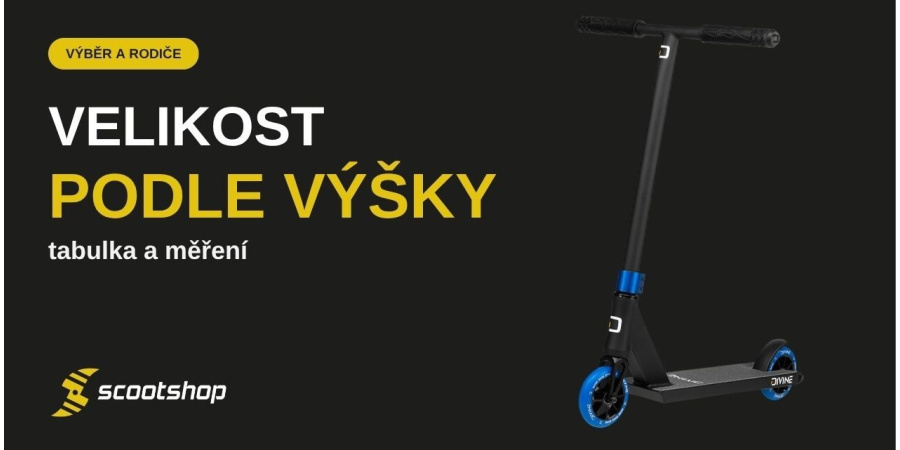
⚡ In short: the right size = handlebars between the navel and waist when the child is standing on the deck.
A freestyle scooter cannot be adjusted in height, so it is chosen based on the rider’s height, not age. A child who is 110–120 cm tall should use a scooter with an overall height of 72–75 cm, a child who is 140–150 cm tall 80–84 cm, and a rider who is 160–170 cm tall 88–94 cm. The entire table is below.
If your child is between two sizes, choose the larger one. Once they outgrow the scooter, you only need to replace the handlebars, not the whole scooter.
📏 Height, not age
The age on the box is just a guideline. A child's centimeters make all the difference.
🎯 Navel to waist
The handlebars should reach up to this point when the child is standing on the scooter deck.
🔍 Two different heights
Overall scooter height ≠ handlebar height. The total is specified for the set.
🌱 Between sizes
Take the higher one. One size up, never two.
🔧 Outgrown? Handlebars
New handlebars are cheaper than a new scooter, and you can do it at home too.
Find your child’s height in the left column, and the total height of the scooter you’re looking for in the right column. The overall height is measured from the ground to the top edge of the handlebars and can be found in the specifications for every set in our range.
| 👤 Rider height | 🛴 Total scooter height (from the ground to the handlebars) |
| up to 100 cm | 65–69 cm |
| 100–110 cm | 69–72 cm |
| 110–120 cm | 72–75 cm |
| 120–130 cm | 75–77 cm |
| 130–140 cm | 77–80 cm |
| 140–150 cm | 80–84 cm |
| 150–160 cm | 84–88 cm |
| 160–170 cm | 88–94 cm |
| 170–180 cm | 94–100 cm |
| over 180 cm | 100 cm or more |
The table is based on the rule “handlebars between the navel and the waist” and corresponds to what what most brands use. It’s a general guideline, not a hard-and-fast rule: street riders tend to prefer a taller scooter, while park riders prefer a lower one (more on that below).
Why height and not age? Two ten-year-old children can be 130 cm and 150 cm tall, and each needs a different scooter. Age only gives you an idea of what a child can handle on a scooter; we discuss this in the article What age is a freestyle scooter suitable for?.
This is the most common source of confusion. With freestyle scooters, you'll come across two numbers that look similar but mean different things:
The difference between the two numbers is the height of the remaining scooter components: the wheel, fork (the part that holds the front wheel), and clamp (the clamp that secures the handlebars to the fork). With the set of 110 mm wheels, it comes to about 20–25 cm.
💡 How to calculate the total height after changing the handlebars
Measure from the ground to the bottom edge of the clamp and add the height of the new handlebars. The exception is the SCS system (a large clamp that also acts as a compression system, connecting the handlebars to the fork): there, you measure from the ground to the center of the clamp, because the handlebars only sit halfway inside it. You can find out which system you have by following our guide Compression Systems Guide.
All you need is a meter stick, a step or a thick book, and a broom handle. The measurement takes two minutes and directly gives you the number you’re looking for in the table.
Example: A child who is 118 cm tall, wearing shoes, stands on a 5 cm book; the handle is 74 cm above the floor, between the navel and the waist. Are you looking for a scooter with an overall height of around 74 cm? See the 72–75 cm row in the table.
If the measurement doesn’t match the row for the child’s height (long legs, short torso), trust the measurement. A scooter is chosen based on where the child’s hands are, not their overall height.
Take the higher one. There are three reasons:
This is doubly true of a Christmas gift: people don’t ride much during the winter, and by spring the child is 2–3 cm taller. One size up is fine, two is not. With the handlebars above waist height, it's hard to jump, and the scooter ends up in the garage.
For completeness: some brands advise choosing the smaller size if you’re unsure, because a lower scooter is more maneuverable for tricks. This applies to a child who can already jump. For a beginner and a growing child, we keep it “higher.”
Replace the handlebars when they reach below the navel of a child standing on the deck, or when the child complains that they have to hunch over. Measure the figure approximately every six months.
You don't need to buy a new scooter because of the height. The deck, fork, wheels, and brake remain the same; only the handlebars change, and possibly the grips (rubber handles). It’s a 15-minute job with Allen keys. With new handlebars, keep an eye on three things:
💡 Tightening sequence after replacement
First tighten the compression bolt (the bolt that clamps the fork into the frame), align the wheel with the handlebars, and only then tighten the stem clamp bolts diagonally.
In reverse, it grinds or knocks. The procedure is in the guide How to assemble a new freestyle scooter.Not for a beginner; the table applies. The difference comes only with riders who know what they want to ride:
If the child does not ride either one yet, choose according to the table. The style will become apparent in a year or two and can be fine-tuned by replacing the handlebars.
| Child | Table row | Recommended total height | Note |
| 6 years, 118 cm | 110–120 cm → 72–75 cm | 75 cm (upper end of the range) | They’ll be over 120 cm by spring, so choose 75, or even 76–77 cm. Above all, as light a scooter as possible, around 3 kg. |
| 10 years, 140 cm | exactly on the boundary between 130–140 / 140–150 cm | 80–82 cm | A typical “between sizes” case. Higher row, 80–84 cm, but at the lower end of that range. 110 mm wheels. |
| 14 years old, 165 cm | 160–170 cm → 88–94 cm | 90–92 cm | The middle of the range is a safe choice. Choose a sturdier scooter for a heavier rider; a street rider can comfortably ride a 94 cm one. |
To be on the safe side, take measurements at home for each one. You can find the prices and what you get for them in the guide How to choose a freestyle scooter for a child or beginner.
A child who is 120 cm tall is on the boundary between the 110–120 and 120–130 cm rows; choose the higher one: overall height 75–77 cm.
Overall height 84–88 cm. If the child is still growing, at the upper limit (86–88 cm).
A rider who is 170 cm tall is right on the borderline: 94 cm in total height is a good middle ground. A rider who is 180 cm tall needs 100 cm or more, meaning handlebars from a higher-end range that standard children’s sets usually don’t include.
Between the navel and the waist when the rider is standing on the board. Advanced riders often ride lower, but beginners should stick to this rule.
Ne. A solid connection is essential for the scooter to withstand impacts. The height can only be changed by replacing the handlebars with different ones or by shortening the existing ones.
One size up, yes; two sizes up, no. When she outgrows it, you can replace the handlebars—not the whole scooter.
Tell us your child’s height (ideally including the result of a measurement taken at home), or stop by our store in Pardubice, where your child can try out the scooter right away. You can find complete sets in the freestyle scooters category, and more guides in the Guides section.