Trampoline and snow scooters: what are they and why aren’t they freestyle scooters?
21. October
Entire article
Written by Martin Nogol, Scootshop.cz · Updated on the 14th. 10. 2026
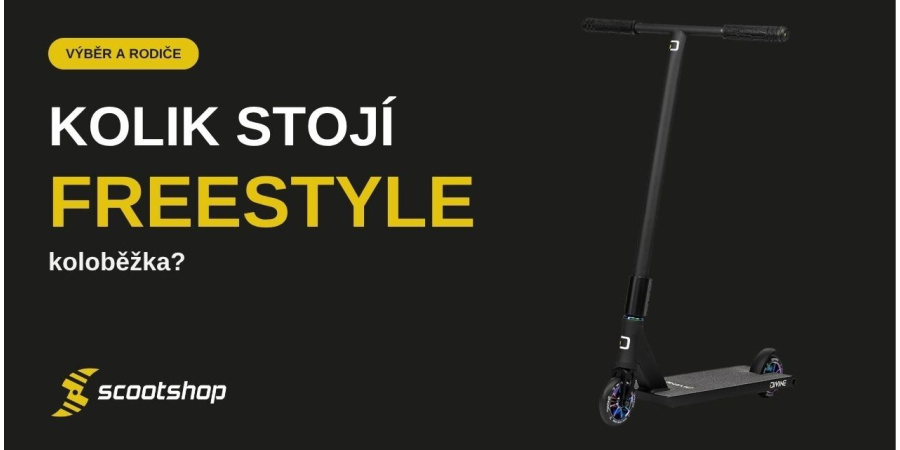
⚡ In short: a decent freestyle scooter for a beginner costs CZK 2,000–4,000.
For a younger child, budget CZK 2,000–3,000; for an older beginner or an adult, budget CZK 2,500–4,000. The mid-range option for regular riders is 4,000–6,000 CZK; professional equipment starts at 6,000 CZK. For under CZK 2,000, you’re buying a scooter that won’t withstand jumps.
The price does not change the label, but the parts: bearings, wheels, handlebars, compression system, headset and deck.
Exactly in this order, these are the parts that fail on cheap scooters.💰 CZK 2,000–4,000
A range offering beginners the best balance of price and battery life.
🧰 You pay for parts
Bearings, wheels, handlebars, compression, headset, deck. Not for the color and sticker.
🔧 Consumable Parts
Wheels, bearings, grips, and griptape can be replaced. Please take this into account in the budget.
📈 Improve piece by piece
A good set doesn't need to be replaced in its entirety. Replace whatever is currently holding your child back.
🚫 Under CZK 2,000
We don't recommend using tricks. It can handle rides, not impacts.
Five price tiers. The ranges overlap a little because a smaller child needs a smaller scooter, which tends to be cheaper than an equally good scooter for an adult.
| 💰 Price | 👤 Typical rider | 🧰 What you get | 🔩 How the parts differ |
| up to CZK 2,000 | Not recommended for tricks. | Riding on flat ground.A scooter that looks like a freestyle scooter but won't withstand jumps. Often irreparable. | Wheels with plastic cores, cheap bearings, a non-integrated headset, a threaded connection instead of compression, thin handlebars, non-standard dimensions. |
| 2,000–3,000 CZK | Younger beginner: a smaller, lighter child, roughly up to 140 cm. | A proper freestyle scooter from a brand that makes scooters. It can withstand the first jumps and can be repaired. | 100 or 110 mm wheels with an aluminum core, 608 bearings, integrated headset, IHC compression, steel handlebars, aluminum deck. |
| 2,500–4,000 CZK | Older beginner: 11+ years old, teenager, adult. | A sturdier and larger scooter for heavier riders and bigger jumps. A foundation for years to come, one you can keep improving. | 110 mm wheels, stronger steel handlebars (often oversized at 35 mm), IHC or HIC compression, a wider and longer deck, higher-quality bearings. |
| 4,000–6,000 CZK | Intermediate: rides regularly and tries more difficult tricks. | A lighter yet stronger scooter. You’ll notice the difference during wipes and rotations. | 110–120 mm wheels with a lightweight aluminum core, HIC or SCS compression, aluminum or lightweight steel handlebars, a deck with a shaped underside for grinds, and more precise bearings. |
| 6,000 CZK and up | Advanced rider, racer. | Premium complete scooters or a custom scooter built from individual parts. | SCS compression, titanium or premium steel handlebars, a higher-end deck and fork, wheels to suit your style (park/street), with every component individually configurable. |
Prices are indicative ranges from our offerings as of October 2026.
Choosing a size based on your child’s height and the complete selection process are covered in the guide How to Choose a Freestyle Scooter for a Child or Beginner.
A more expensive scooter costs more not because of its design, but because every component is a class better:
You can find a summary of all the parts with explanations in the article What Is a Freestyle Scooter Made Of? .
Pay extra (from “up to CZK 2,000” to CZK 2,000–4,000) when:
Pay extra (from CZK 2,000–4,000 to CZK 4,000–6,000) if:
Don't pay extra when:
💡 Better than paying extra for the whole set: upgrade piece by piece
A good beginner scooter is a kit. Your child grows: you replace the handlebars. Wheels are wearing out: buy better wheels. Wants a firmer connection: switching to SCS. Every step costs a fraction of the price of a new scooter. That’s why it makes sense to start with a complete set whose parts you’ll still be able to find even two years from now.
A freestyle scooter has consumable parts, just like a bicycle. It is normal wear and tear, not a defect, and it is not covered by the warranty. How often the parts are replaced depends mainly on how often the vehicle is driven. Best practice: at the beginning of each season, check everything and replace anything that is damaged.
| Part | Why it wears out | When to replace |
| 🛞 Wheels | The polyurethane wears down, especially on the rear wheels (braking, impacts). | When the polyurethane is worn down, has a flat spot, or is peeling away from the core; the rear one usually wears down sooner. It helps to swap them. |
| ⚙️ Bearings | Water and sand destroy them. They are replaced when they crunch or don’t spin freely. | When they crunch, grind, or don’t spin freely; they wear out quickly after riding in the rain or sand. |
| ✋ Grips | They tear during falls. | When they are torn, worn through, or sticky; sooner for a beginner who falls frequently. |
| 🧻 Griptape | “Sandpaper” on the board. It is cooling down and no longer holding. | As soon as the shoes start slipping. |
| 🛑 Brake | The sheet metal wears out, especially above a worn wheel. | When the disc cracks or stops braking. |
Handlebars, deck, fork, and headset are not consumables. It lasts for years and can be adjusted as the child grows (handlebars) or changes their style.
How to make the parts last longer: don’t ride in the rain, don’t constantly brake with the rear brake, and wipe them down after riding. You can find everything in the freestyle scooter maintenance category and in the freestyle scooter parts category.
Because it is not the same product. A scooter costing a few hundred is built for riding on flat ground and for the price in the flyer. A freestyle scooter has to withstand impacts of two to three times the rider’s weight a hundred times in a single afternoon. There is a difference in every part:
In practice, a 900 CZK scooter will last a child who jumps on it a few weeks to a few months. Then you end up buying freestyle for CZK 2,000–3,000 anyway, and you've paid for both. Between CZK 3,000 and CZK 6,000, the difference is in the weight and durability of the parts for an advanced rider—not in whether the scooter will survive its first jump.
You can find a detailed comparison of the construction in the article Freestyle vs. ordinary scooter, a comparison of buying from a chain store and a specialist shop in the article Freestyle scooter from a chain store or a specialist shop?
For a younger child, CZK 2,000–3,000; for an older beginner or an adult, CZK 2,500–4,000. It can withstand jumps and can be repaired.
Yes for riding on flat ground, not for tricks. Under CZK 2,000, you'll find wheels with plastic cores, a non-integrated headset, and a weak compression system. Not recommended for jumping.
The weight and strength of the parts: lighter wheels, better compression (HIC/SCS instead of IHC), aluminum or titanium handlebars, a stronger deck. For a beginner, the difference is small; for an advanced rider, it’s decisive.
The consumable parts are wheels, bearings, grips, and griptape. How often they are changed depends on how often they are used; at the beginning of each season, check everything and replace whatever is damaged. The handlebars, deck, and fork will last for years.
Always complete for beginners. Custom costs more and only makes sense once the rider knows what they want from each component. Typically from CZK 6,000.
Write to us or stop by our store in Pardubice, and we’ll tell you what makes the most sense for your budget. You can find all complete scooters in the freestyle scooters category, and more guides in the Guides section.