Trampoline and snow scooters: what are they and why aren’t they freestyle scooters?
21. October
Entire article
Written by Martin Nogol, Scootshop.cz · Updated on the 14th. 10. 2026
⚡ In short: the fork determines two things. What compression system does the scooter have, and what size wheel fits it?
Two types are sold today: SCS/HIC forks (a thicker steerer tube with a built-in thread, for SCS and HIC compression) and IHC forks (a thinner steerer tube, the lightest type, most common on complete scooters; only fits handlebars with an inner diameter of 28 mm).
When replacing it, buy the same type as the one you have; otherwise, you will also have to replace the handlebars and the clamp.Wheel: the standard 110 × 24 mm fits almost every fork; 120 mm wheels and a 30 mm width depend on the specific product.
The shaft is 8 mm. Replace the fork if the steerer tube is bent or cracked.🔩 Fork = compression
SCS/HIC fork, or IHC fork.
Then the handlebars and clamp go onto it.🛞 110 × 24 mm
Standard wheel, fits almost every fork. Larger based on the product alone.
📐 8 mm axle
Standard for 608 bearings. 12STD (12 mm) is marginal, mainly Ethic.
🪶 Lightest IHC
That’s why it is included with most sets. SCS/HIC is stiffer and heavier.
🚨 Bent post
The fork is not straight. Bent or cracked, it is replaced.
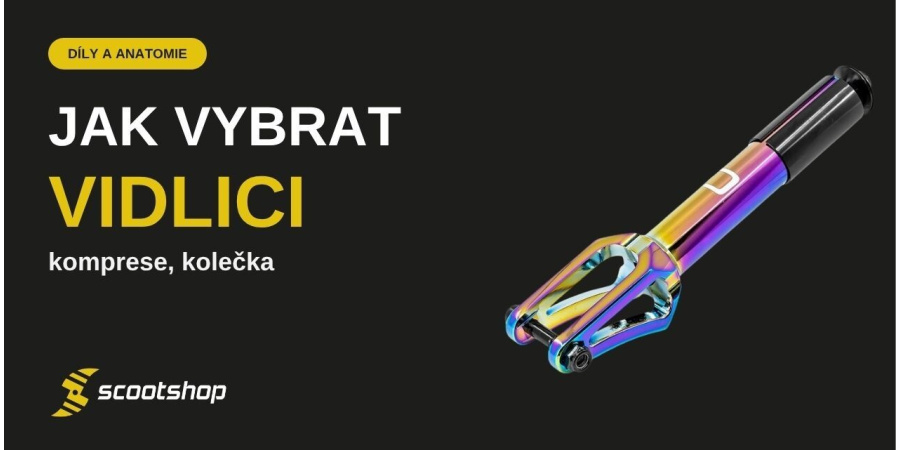
The fork is the part that holds the front wheel and connects it to the handlebars. It consists of three parts:
Forks are replaced infrequently: if they bend or crack, or if you want larger wheels or a different compression system. The fork is always the first part you choose, and the rest are selected to match it: the handlebars, clamp, and front wheel are bought to fit it.
Compression is the way the fork is tightened against the deck so that the handlebars have no play. We discuss it in detail in our article SCS, HIC and IHC compression systems; here, we’ll focus only on what matters when choosing a fork. Today, there are two types of forks:
The historical system is ICS (a screw at the bottom of the fork), a press-fit “star nut” instead of a thread, and threaded forks with two locknuts, which are still found on the cheapest scooters. You can hardly find parts for them these days; converting to IHC or SCS/HIC (fork + handlebars + clamp) is the more sensible option.
💡 A parenting shortcut
Don't know which fork you have? Check what is written on the handlebars or the existing fork (IHC, HIC, SCS). Buy the same type and you won’t have to change anything else. How can you identify compression by looking at it? We have this in our compression article, in the section “How to tell what compression you have.”
Each fork has a specified maximum diameter and width of the wheel. Three rules:
Before buying a fork, write down the diameter and width of the wheels you have and compare them with the fork description. The larger wheel must also fit through the deck and under the brake; for more information, see our article “Which wheel will fit my fork, deck, and under the brake?” The wheels themselves are explained in the article How to Choose Wheels.
Handlebar diameters are given as outer / inner in mm. More in the article How to Choose Handlebars.
| Compression | 🔱 Fork | 🪢 Handlebars | ⭕ Clamp | 👤 For whom |
| SCS | SCS/HIC fork (thicker steerer, built-in thread) | Any without a notch (32/28, 35/32, 35/28); with a slit only when used with a bar adapter | SCS clamp (compression inside) | Heavier riders, street, maximum strength |
| HIC | Same SCS/HIC fork + HIC shim | Only oversized notched 35/32 steel/titanium | Standard 35 mm | Advanced, who want strength without the weight of SCS |
| IHC | IHC forks only (thinner steerer tube, integrated thread) + IHC ring for the headset | Internal 28 mm with a notch: steel 32/28 or aluminum 35/28. 35/32 never | Standard 32 mm (steel) or 35 mm (aluminum) | Children, beginners, most complete bikes |
| ICS, threaded | History. ICS fork (bolt underneath), threaded fork with nuts | Old handlebars with a star nut, standard 32/28 | Common | Oldest and cheapest scooters; parts are no longer sold |
You can find forks in the freestyle scooter forks category, compression parts in the HIC, IHC, shims and SCS categories.
One-piece aluminum is the modern standard: the fork is milled or forged as a single piece, with no welds, making it lightweight and strong. Steel welded fork (a tube welded to the legs) is cheaper and heavier, and the weld is a weak point; you’ll find it on the cheapest builds, often in a threaded version. For jumps and tricks, choose a one-piece aluminum scooter. Don't worry about the specific alloy; it doesn't affect the selection.
Offset is the distance between the wheel axis and the column axis.
A fork with offset (the axle positioned forward) rides more stably; a “zero-offset” fork (the axle directly below the steerer tube) is more playful for nose manuals. A beginner won’t notice the difference; we mention it only so you know what it means in the description.💡 What is usually included with the fork
Always a little axle for the wheel. Depending on the compression system, sometimes a shim and C-ring are used (for IHC). Check the rest in the description of the specific product.
You can easily extend its lifespan: keep the compression properly tightened (with no play, but not “as tight as possible”), the wheel axle tightened (a loose axle damages the holes in the fork), and avoid riding in the rain or through puddles. You’ll notice a material defect during your first rides and can report it under the warranty according to the How to Make a Warranty Claim guide.
Based on the handlebars: if you have standard steel (32 mm outer diameter) or aluminum handlebars, the fork is IHC. If you have an oversized 35/32 steel bar or an SCS clamp, the fork is SCS/HIC. The IHC column is also visibly thinner. The type is usually also written on the fork.
Only if the manufacturer specifies this for the fork. The standard is 110 mm; 120 mm varies by product. And it must pass through the board and under the brake as well.
If you buy the same type of fork (IHC for IHC, SCS/HIC for SCS/HIC), no. The handlebars, clamp, and headset remain. You only change them when the compression type changes.
IHC: it is the lightest and fully sufficient for children’s weight and jumps. SCS/HIC is worthwhile for heavier riders and hard street riding.
Practically not. A more sensible option is to convert it to IHC: a new fork, handlebars, and clamp. We’ll be happy to advise you in store.
Write to us or bring your scooter to our store in Pardubice; we’ll select and replace the fork on the spot, even if you bought the scooter elsewhere. You can find forks in the forks category. Related articles: Compression Systems, How to Choose Handlebars, How to Choose a Deck, Headset, and How to Choose a Clamp. Another guide in the Guides section.