Trampoline and snow scooters: what are they and why aren’t they freestyle scooters?
21. October
Entire article
Written by Martin Nogol, Scootshop.cz · Updated on the 14th. 10. 2026
⚡ In brief: a freestyle scooter is a kit made up of around 14 types of parts, and every one of them can be replaced.
The setup consists of a deck, fork, headset, compression system, clamp, and handlebars; these will last for years. Grips, grip tape, wheels, bearings, and the brake are consumable parts. Most repairs involve replacing a single consumable part, not buying a new scooter.
The only thing that needs to “fit” is the compression system (SCS, HIC, or IHC; the older ICS is no longer used). It determines which handlebars and clamp fit the scooter.
🧩 Construction kits
Approximately 14 types of parts, all interchangeable. Nothing lasts forever; nothing is lost.
🛞 110 mm
Today's standard wheel diameter. Easiest to buy more of.
🔩 4 compression systems
SCS, HIC, IHC (ICS is history).
The fork determines this; the handlebars and stem clamp are selected accordingly.⚙️ 4 bearings
Two in each wheel, type 608 for an 8 mm axle. The most frequently replaced consumable part after the grips.
🔧 Compression before the clamp
The only order in which the scooter stays tight without any play.
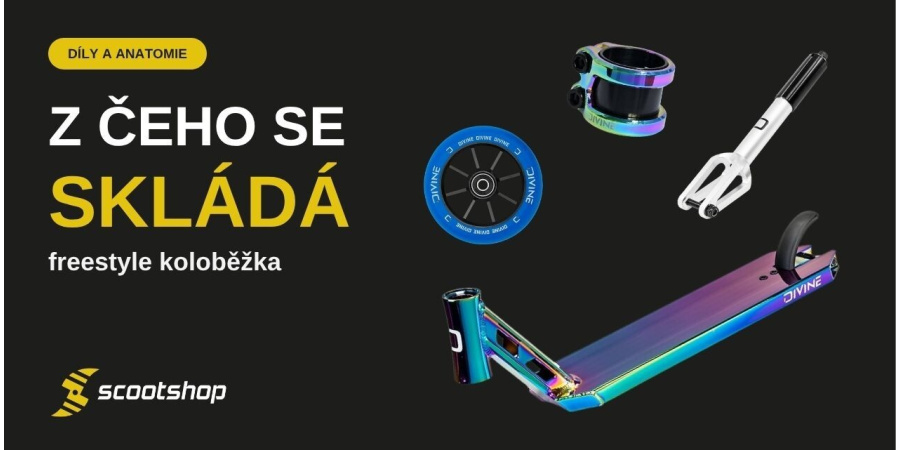
From top to bottom: grips and bar ends, clamp, with the compression system underneath that pulls the handlebars, headset, and fork together. The fork passes through the plate and carries the front wheel. Rear wheel with a brake, grip tape on the deck. Each wheel has two bearings, a spacer, and an axle.
| Part | English | What it does | Part type |
| Deck | deck | The supporting frame that you stand on and which holds the wheels and fork. | Long-term |
| Fork | fork | Holds the front wheel and passes through the deck to the handlebars. | Long-term |
| Headset (head assembly) | headset | Two bearings that allow the fork to rotate in the deck. | Long-term |
| Compression | compression | Clamps the handlebars, headset, and fork together as a single unit without play. | Long-term |
| Clamp | clamp | Clamps the handlebars to the fork. | Long-term |
| Handlebars | bar / bars | Steering and grip; they determine the scooter’s height. | Long-term (changes as the child grows) |
| Grips | grips | Rubber handles. | Consumable |
| Bar ends | bar ends | Plugs at the ends of the handlebars that protect your hands and the tube. | Consumables |
| Wheels | wheels | Core + polyurethane tread, 2 pieces. | Consumables |
| Bearings | bearings | For the wheels to turn, 4 pieces. | Consumable |
| Axles and spacers | axles, spacers | Bolts that hold the wheels in place, and spacer sleeves. | Long-term |
| Brake | brake | A plate above the rear wheel that brakes when pressed. | Consumable |
| Griptape | grip tape | Non-slip sandpaper-like material on the deck. | Consumable |
| Pegs | pegs | Metal tubes fitted to the axles for grinds (optional). | Long-term, optional |
If you count each piece separately (2 grips, 2 end caps, 2 wheels, 4 bearings, 2 axles, spacers), you get roughly 20 parts excluding the screws. They are all in the freestyle scooter parts category.
Because a freestyle scooter is a build kit: every part can be unscrewed and replaced. Two practical consequences:
Only compatibility is checked: the handlebars and clamp must match the fork compression system, and the wheel must fit the fork and deck. The rest is a matter of an Allen key. If you’re just choosing a complete scooter, start with our guide How to Choose a Freestyle Scooter.
The deck is the scooter frame made from a single piece of aluminum. At the front, it has a head tube through which the fork passes; at the rear, it holds the rear wheel and brake. It takes the most abuse: people stand on it, land on it, and grind on it.
What to look for when choosing:
How often is it replaced: practically never, unless it bends or cracks. After a hard crash, check for hairline cracks around the welds and the head tube.
Category: decks for freestyle scooters.
The fork holds the front wheel, and its steerer tube passes up through the deck to the handlebars, where the compression system and clamp sit. Today, made from a single piece of aluminum; old steel threaded forks are no longer used.
What to look for when choosing:
How often is it changed: rarely, usually when converting to a different compression system or larger wheels.
Category: forks for freestyle scooters.
The headset consists of two bearings in the board’s head tube, in which the fork rotates. Without it, neither a tailwhip nor a barspin would be possible. It includes a compression ring (C-ring) around the fork steerer tube and a dust cap (top cap).
What to look for when choosing:
How often is it replaced: rarely, only when the bearings start to seize up. More often, it’s enough to clean it and lubricate it with petroleum jelly.
Category: headsets for freestyle scooters.
Compression pulls the handlebars, headset, and fork together so there is no play in the steering, while still allowing the handlebars to turn smoothly. Three common systems (and the historical ICS); the fork determines the type, then choose the handlebars (diameter, slit) and clamp to match.
| System | How it works | Handlebars | Who it's for |
| SCS | The compression system is integrated into the clamp with 4 bolts. | Without a notch (standard and oversized). | The strongest and heaviest, advanced. |
| HIC | Shim (spacer) on the fork, bolt with a cap on top. | Oversized steel or titanium, with a notch. | Mid-range and higher-end. |
| IHC | Like HIC, but the fork has a narrower steerer tube. | Standard (inner diameter 28 mm), with a notch. | The lightest, most common in beginner sets. |
| ICS (historical) | The bolt goes from underneath the fork up into the handlebars. | With a notch. | Not used today; only old scooters. |
How often it is changed: it is not changed, only tightened, always before the clamp. The goal is to find the “sweet spot”: no play, but not tightened to the point of being “as tight as possible”; the handlebars must still turn freely.
In detail, including compatibility rules, in the guide Compression Systems Explained. Parts: HIC, IHC, ICS compression and shims and SCS.
An aluminum ring with 2–4 bolts that clamps the handlebars around the fork steerer tube. For SCS, it is also the compression component; for HIC and IHC, it is a separate part.
What to look for when choosing:
How often does it change: practically never. Tighten the screws in a crisscross pattern, only after compression.
You can find clamps in the clamps category.
T- or Y-shaped pipe. They determine the scooter’s height, so they are the first parts to be changed as the child grows. Handlebars (as people often type into a search engine) can be shortened, not lengthened.
What to look for when choosing:
How often to change: as the child grows. Bent or cracked ones cannot be repaired; they must be replaced.
Category: freestyle scooter handlebars, guide How to choose handlebars.
Grips are rubber handles on the handlebars. Bar ends are plugs at the ends of the handlebar: they protect your hands from sharp edges in a fall and keep the grips in place. They are important, not an add-on.
What to look for when choosing:
How often should they be replaced: Grips more often than any other parts; sooner if you fall frequently. Replace them when they become sticky, torn, or worn through: cut off the old ones and put on new ones with a little hairspray or rubbing alcohol. End caps, when they break or get lost.
You can find grips and bar ends in the freestyle scooter parts category.
Core (aluminum or plastic) and polyurethane (PU) tread. Small and hard, because it has to withstand impacts and lateral loads during whips.
What to look for when choosing:
How often should they be changed: the rear ones wear down faster, so the wheels are swapped around occasionally. Replace them when the PU is worn, has a flat spot caused by brake lockup, or is peeling away from the core. How quickly it arrives depends on how often the trips are made.
Category: wheels for freestyle scooters, guide All about wheels.
Two in each wheel, four on the scooter. They are sold in sets of 4 (2 per wheel + a spacer between them). Almost all freestyle scooters use the 608 type for an 8 mm axle, the same as skateboards and rollerblades.
What to look for when choosing:
How often to replace them: when they crunch, grind, or spin for only a short while after being spun (healthy ones spin for 2–4 seconds). Water and sand are destroying it; WD-40 isn’t a lubricant, it only degreases. They are pressed straight into the little wheels, never hammered in.
Category: bearings for freestyle scooters, guide How to Choose Bearings.
The axle is a strong bolt (typically 8 mm) that passes through the fork or plate and both wheel bearings. A spacer is a distance sleeve between the bearings that prevents them from being compressed together when tightened; additional spacers fill the fork or plate when the wheel is narrower.
What to look for when choosing:
How often should it be replaced: only if it is lost or the thread strips. They are tightened fully; the permissible axle is the most common cause of knocking.
You can find axles and spacers in the freestyle scooter parts category.
Plate above the rear wheel, pressed down with the heel. There is no handbrake. Today, practically always a flex fender (a flexible, pre-bent sheet metal piece that is quiet and simple). Spring brake (with a spring-loaded pin) is an older type found on inexpensive scooters.
What to look for when choosing:
How often it is replaced: consumable part. The Flex fender will eventually crack, especially above a worn wheel. Do not hold the wheel (pad) in place to stop it from turning, and do not overtighten the screws, which are usually 3 mm Allen screws.
Category: brakes for freestyle scooters.
Self-adhesive grip tape on a board, the same as on a skateboard. The foot does not slip thanks to it.
What to look for when choosing:
How often to change it: as soon as it stops holding. Clean it dry with a brush; clean the surface before applying a new board. Because of the grip tape, ride in skate shoes; regular sneakers will wear through in just a few weeks.
You can find griptape in the freestyle scooter parts category.
Metal tubes on the sides of the wheel axles, for grinding on rails and edges. A beginner doesn’t need them, and in general they’re becoming obsolete; they only become relevant once a child starts grinding.
What to look for when choosing:
How often should it be replaced: only when it wears down or bends.
You can find pegs in the freestyle scooter parts category.
Order according to what we change most often. How often it arrives depends on how often it is used; at the start of each season, check everything and replace anything that is damaged.
| Part | When to replace | Replacement difficulty |
| Grips | Sticky, torn, chafed | 5 minutes, knife and hairspray |
| Griptape | It will stop sticking, is smooth | 15 minutes, knife and hair dryer |
| Wheels | Worn PU, patch, peeling away from the core | 10 minutes, Allen screw; bearings are pressed back in |
| Bearings | They crunch, They scrape, doesn't rotate | 15 minutes, a press or skilled hands needed |
| Brake | Cracked sheet metal, not slowing down | 5 minutes, imbus 3 mm |
| Handlebars | The child has grown, bent, burst | 15 minutes, compression + bushing |
Board, fork, headset, compression, socket, Axles and pegs are long-term components. It will last the entire lifetime of the scooter. Care: freestyle scooter maintenance.
Approximately 14 types of parts (deck, fork, headset, compression system, clamp, handlebars, grips, bar ends, wheels, bearings, axles, spacers, brake, griptape), or 15 with pegs. In pieces, without screws, around 20 parts.
Usually, yes. The handlebars, wheels, bearings, grips, headset, and clamp are standardized; only the compression system and dimensions need to match. Exceptions include brakes, pegs, and spacers, which are tied to a specific board.
Grips, griptape, wheels, bearings, and brake. They are consumable parts, and replacing them is a normal part of operation, not a defect.
Based on the clamp: four bolts and a compression bolt in the middle of the clamp means SCS. Two bolts and a cap with a bolt above the clamp is HIC or IHC (they differ in handlebar diameter). The screw at the bottom of the fork is the old ICS type; it is no longer used. In detail in the guide How to Use Compression Systems.
That it has no play or knocking: the compression and sleeve are tightened, the axles are secure, and nothing rattles. This and other terms are explained in our Freestyle Scooter Glossary.
Bring the scooter to our store in Pardubice; we’ll identify the part and replace it on the spot, or send us a message. You can find all the parts in the freestyle scooter parts category, and more guides in the Guides section.